

Learn mentalism
Mentalism vs Magic: The Real Differences
Same toolbox, different promise. How mentalism magic differs from conjuring, where the line blurs, and why it matters to performers.
 By The MentalismPro TeamUpdated

Mentalism vs magic is an argument performers have been having for a century. Some mentalists insist they are not magicians at all. Most magic historians file mentalism as a branch of magic. Both sides have a point. Mentalism magic uses many of the same methods as conjuring, but it makes a different promise to the audience, and that promise changes almost everything about how an effect is chosen, scripted and performed.
This guide sets out the real differences between a mentalist and a magician, the places where the two arts overlap, a classic routine that shows how one principle can be presented either way, and some honest advice on which to learn first.
Is Mentalism Magic?
By most definitions, yes. Mentalism is commonly classified as a subcategory of magic, alongside close-up, stage illusions and escapes, and many of its founding texts were written by magicians for magicians. Theodore Annemann's magazine The Jinx, a cornerstone of mentalism in the 1930s, was read across the whole magic world. Tony Corinda's 13 Steps to Mentalism (1961) includes plenty of techniques any magician would recognize.
Why Many Mentalists Reject the Label
Many professional mentalists distinguish their work from magic tricks, describing what they do as creating psychological experiences rather than puzzles. The reason is practical. The moment an audience files something under "magic trick", it starts looking for the method. If the same audience files it under "psychology" or "intuition", it relaxes into the experience. The label changes how the effect lands.
Is a Mentalist a Magician?
Technically, a mentalist is a magician who specializes in effects of the mind. In practice, the two are different jobs with different audiences, different shows and different personas. A wedding planner booking "a magician" and one booking "a mentalist" expect different evenings. For the full picture of the art itself, start with our guide on what a mentalist is.
Mentalism vs Magic: The Real Differences
| Magic | Mentalism | |
|---|---|---|
| The premise | Objects do impossible things | Minds do impossible things |
| Typical effects | Vanishes, productions, transformations, levitations | Mind reading, predictions, influence, drawing duplication |
| Props | Varied and often visual: cards, coins, silks, apparatus | Few and ordinary: paper, pens, envelopes, books |
| The spectator's role | Watches, sometimes holds or signs something | Thinks, chooses, writes; is the center of the effect |
| Pacing | Often quick, many effects in a set | Slower, fewer effects, each one built up |
| Imperfection | A miss is a failure | A near miss can make a hit more convincing |
| What the audience asks afterward | "How did they do that?" | "How did they know that?" |
The Premise
A magician says, in effect: watch this coin disappear. A mentalist says: I'll tell you what you are thinking. The first invites the audience to watch the performer's hands. The second points the attention at the spectator's own mind, which is a place the audience cannot inspect for clues.
The Props
A mentalism set often fits in a jacket pocket: a notepad, a marker, a few envelopes, maybe a deck of cards. That restraint is deliberate. A strange-looking box or a flashy apparatus tells the audience a gadget is doing the work, and that kills the idea that the mind is. Where mentalists do use gimmicks, they tend to be invisible or disguised as everyday objects.
The Spectator
In magic, the spectator often helps. In mentalism, the spectator is the effect. Their thought, their choice and their reaction are the content of the show, which is why mentalism tends to work well for small groups and why audience management is half the skill.
Pacing and Tone
A close-up magician might perform eight effects in ten minutes. A mentalist might perform two, because each one is built slowly: the setup, the choice, the struggle to "receive" the thought, the reveal. The tone is usually more serious, more intimate and more conversational.
Too Perfect Is a Problem
A magic trick should work cleanly every time. A mind reading effect that is flawless every time starts to look like a trick, because real intuition would be messier. Mentalists often build in hesitation, a partial hit or a correction before the final reveal. Magicians call the general issue being "too perfect", and it is one of the most discussed ideas in the craft.
Where Mentalism and Magic Overlap
For all the differences in presentation, the two arts borrow freely from each other, and many performers do both. Here is where the overlap is biggest.
Shared Methods
Forces, switches, secret writing, peeks, mathematical principles and card sleights all appear in both arts. The same force can make a card trick work or make a mind reading feel inevitable. Annemann's 202 Methods of Forcing (1933) was written for magicians and mentalists alike.
Mentalism Magic Tricks
"Mentalism magic tricks" usually means effects that sit right on the border: a card thought of and later found reversed in the deck, a prediction revealed from a sealed envelope, a book test, a borrowed object found by a blindfolded performer. Card magicians add mental-style effects to their sets because they hit an audience differently, and mentalists use cards because people trust an ordinary deck. Our main page of mentalism tricks covers effects you can learn and perform.
Bizarre Magick
Between the two sits a smaller genre, often spelled "bizarre magick", that uses storytelling, old artifacts and dark or folkloric themes. It borrows the mood of séance and occult tradition while staying a theatrical performance.
Routine
One Principle, Two Presentations: The Three Predictions
- Level
- Beginner
- Setup
- None
- Running time
- 3 minutes
The effect
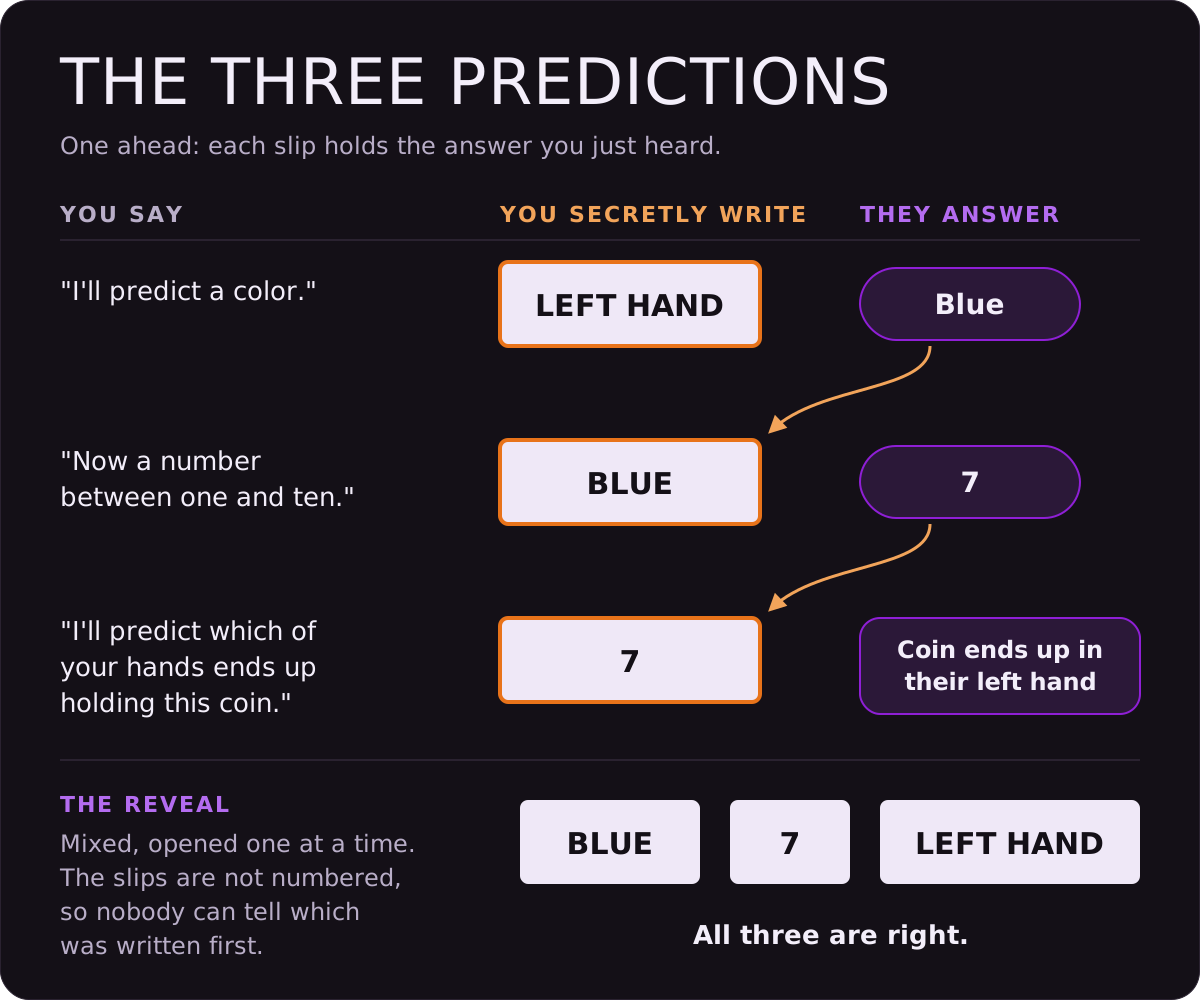
You write three predictions, one at a time, and drop each in a glass: a color the spectator will name, a number they will name, and the hand that will end up holding a coin. At the end the three slips are opened and all three are right.
You need
- Three small slips of paper
- A pen
- A glass or cup
- A coin
-
The secret first slip
This uses the one-ahead principle, one of the oldest and most widely published ideas in mentalism. Say you will predict a color. On the first slip, without letting anyone see, write LEFT HAND. Fold it and drop it in the glass.
-
Ask for the color
Ask the spectator to name any color. Suppose they say blue. React as though you are pleased, without saying whether you got it.
-
Stay one step ahead
Say: "Now a number between one and ten." Pick up the second slip and write as if predicting it, but write the color they just named: BLUE. Fold it and drop it in. Ask them for the number. Suppose they say 7.
-
The last prediction
Say: "Last one. I'll predict which of your hands ends up holding this coin." On the third slip write the number they just gave: 7. Fold it and drop it in. Now hand them the coin and ask them to hold it in their left hand, or place it there yourself as a final gesture.
-
The reveal
Tip the slips out, mix them casually, and open them one at a time: blue, 7, left hand. Because the slips are not numbered, nobody can tell which was written first.
Presentation notes
As magic: present it fast and light, as a puzzle ("I'll write before you choose, every time"), and the audience enjoys the challenge. As mentalism: slow down, ask the spectator to visualize the color, hesitate over the number, and talk about how people's hands give away decisions. The coin phase becomes a demonstration of influence. Same method, different promise. Never present it as genuine precognition.
Performers Who Cross the Line
The border between the two arts is easier to see in the careers of people who walk across it.
Derren Brown
Derren Brown began as a close-up magician and hypnotist before becoming the best-known mentalist in Britain. His shows are framed around psychology and suggestion, but his own disclaimer lists magic first among his tools, alongside suggestion, psychology, misdirection and showmanship.
David Blaine
Is David Blaine a mentalist? Not usually. He is best known as a street magician and endurance performer. His television specials include effects that look like mind reading, which is why the question comes up, but his work is generally described as magic.
Penn and Teller
The duo are magicians through and through, and outspoken skeptics. They have described the difference between mentalists and psychics in simple terms: mentalists are entertainers whose feats come from practice, psychics claim theirs come from the supernatural. Their position is a useful reminder that the more important line is not mentalism vs magic, but entertainment vs deception, which we cover in is mentalism real.
For profiles of the performers who shaped mentalism, see our guide to famous mentalists.
Should You Learn Magic or Mentalism First?
There is no wrong answer, but each route builds different muscles.
Starting With Magic
Magic, especially card magic, teaches handling, angles, misdirection and the discipline of practice in front of a mirror. Those skills transfer directly to mentalism. The downside is that sleight-heavy magic can take months before a single effect is ready to perform.
Starting With Mentalism
Mentalism is often easier to start, because many effects need no sleight of hand at all. The challenge moves elsewhere: scripting, confidence, managing a spectator and handling the moments when something does not go to plan. Is it hard to learn mentalism? The methods are usually simple; the performance is what takes time.
The Practical Answer
Learn a few self-working mentalism effects to discover whether you enjoy performing for people's minds, add basic card handling as you go, and read the classics. Our learn mentalism plan sets out the order.
Free newsletter
Mentalism, made modern. In your inbox.
Occasional emails from the MentalismPro team: a technique to practice, a routine idea, and the new guides and books worth your time. No spam, unsubscribe any time.