

Tricks & routines
Mind Reading Number Tricks: 6 Math Magic Tricks You Can Do Anywhere
No props, no deck, no preparation: arithmetic principles that let you read numbers, birthdays and hidden digits.
 By The MentalismPro TeamUpdated
As an Amazon Associate we earn from qualifying purchases. How we choose products.

Number tricks are the purest form of mind reading you can perform. There is nothing to inspect, nothing in your hands and nothing to buy: the spectator does everything in their head or on their own phone, and you tell them the result. Behind each one is a piece of school algebra, hidden by a script that makes the steps feel random.
This page teaches six math magic tricks with complete methods, including the classic think of a number trick, the mind reading trick with 3 questions, and how to guess someone's three-digit number. Each routine explains why it works, so you can change the numbers and make it your own.
Why Number Tricks Look Like Mind Reading
Every math magic trick uses one of two ideas. Either the instructions cancel the spectator's choice out, so everyone ends up at the same number (a force), or the instructions encode the choice into a result you can decode (a reveal). Both are invisible to the spectator because they make the choice before the arithmetic starts, and the arithmetic sounds complicated enough to bury it.
Forces: Everyone Ends Up in the Same Place
In a force, the steps include adding or multiplying the original number and later removing it again. Whatever the spectator thought of, the answer is fixed in advance. You can then reveal it in a dramatic way, for example with a written prediction. The famous Gray Elephant from Denmark in our guide to mentalism tricks for beginners is a force of this type.
Decoders: The Result Contains the Secret
In a decoder, the steps multiply the spectator's choice by a known number and add a constant. When they tell you the final result, you subtract the constant and read the original number straight from the digits. They give you the answer without realizing it.
Number Forces
1. Think of a Number: The Answer Is Always 3
The classic think of a number trick, and the right place to start because it teaches the structure of every force on this page.
Routine
Think of a Number
- Level
- Beginner
- Setup
- None
- Running time
- 2 minutes
The effect
A friend thinks of any number and follows a few simple instructions in their head. You tell them the number they ended up with.
You need
- Nothing
- Optional: a folded slip with "3" written on it
-
The choice
Ask them to think of any whole number, as big as they like, and keep it secret.
-
Double and add
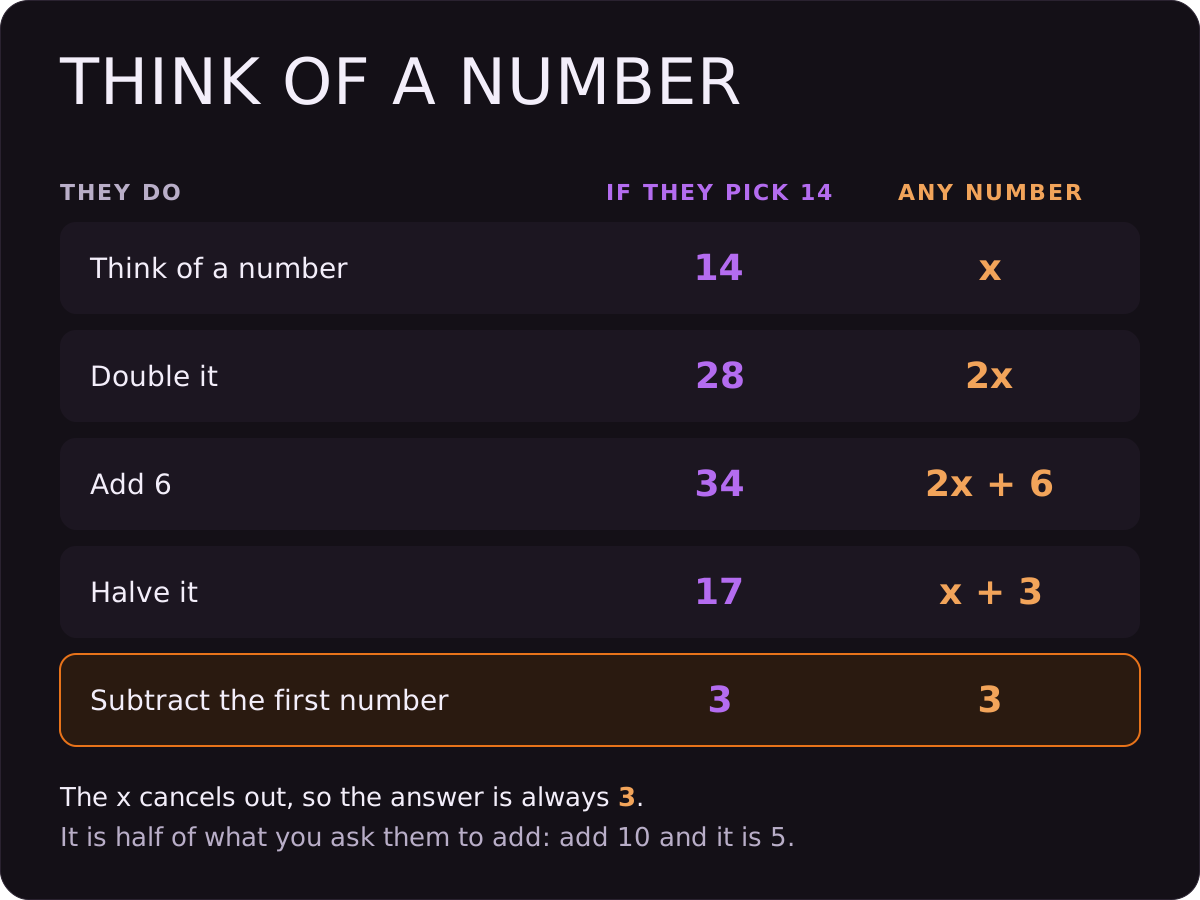
Ask them to double it, then add 6. (If they chose 14: 28, then 34.)
-
Halve and remove
Ask them to halve the result (17) and then subtract the number they first thought of (17 minus 14).
-
The reveal
Their answer is 3, whatever they started with. Name it, or point to the slip you wrote before you began.
Presentation notes
Why it works: doubling the number x and adding 6 gives 2x + 6; halving gives x + 3; subtracting x leaves 3. The answer is always half of the number you ask them to add, so change it each time (add 10 and the answer is 5) and nobody can compare notes.
2. The Mind Reading Trick With 3 Questions
Many of the "3 questions" mind reading tricks shared on social video are versions of the one-ahead principle, an old billet-reading idea from the classic mentalism literature. You write three predictions and get all three right, even though two of the answers are completely free choices. A number force supplies the one answer you know in advance.
Routine
The Three Questions Prediction
- Level
- Beginner
- Setup
- None
- Running time
- 4 minutes
The effect
You announce that you will predict a person's answers to three questions. Before each question you write a prediction and drop it into a cup. They answer freely. When the slips are opened, all three predictions are right.
You need
- Three small slips of paper
- A pen
- A cup or hat
-
First slip
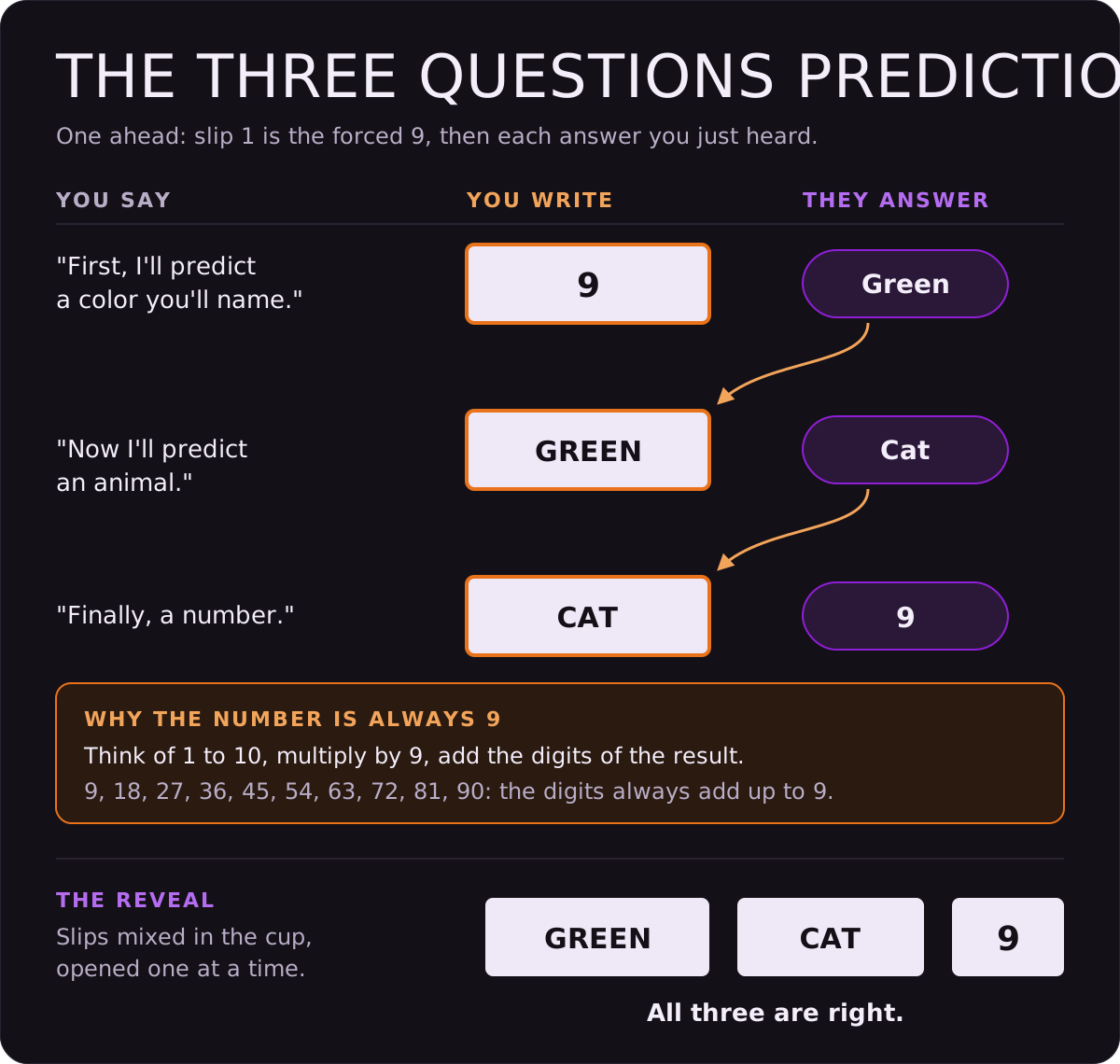
Say: "First, I'll predict a color you'll name." Write on the slip, but write the number 9, not a color. Fold it and drop it in the cup without showing it.
-
First question
Ask them to name any color. Say they choose green.
-
Second slip and question
Say: "Now I'll predict an animal." Write "green" on the second slip, fold it and drop it in. Ask them to name an animal. Say they choose cat.
-
Third slip and question
Say: "Finally, a number." Write "cat", fold it and drop it in. Now ask them to think of a number from 1 to 10, multiply it by 9 and add the digits of the result together. Everyone arrives at 9.
-
The reveal
Tip the slips out, open them one at a time and read: green, cat, 9. Because the slips are mixed in the cup, nobody can tell which was written first.
Presentation notes
The method depends on always being one answer ahead: the first slip holds the forced answer, and each later slip holds the answer you just heard. Write each slip with the same casual speed so none of them seems to take longer. Do the routine once; on a repeat, people watch the order of the slips.
Reading Hidden Numbers
These three routines are decoders. The spectator chooses freely, does the arithmetic on their own phone if they like, and tells you a result that looks meaningless. You read their secret from it.
3. Guess the 3-Digit Number
This one answers the common question of how to guess the 3-digit number someone is thinking of. It works with any number from 100 to 999.
Routine
Guess the 3-Digit Number
- Level
- Beginner
- Setup
- None
- Running time
- 3 minutes
The effect
A spectator thinks of any three-digit number and performs a few calculations. They read out only the final result, and you immediately name their number.
You need
- A calculator or phone for the spectator
-
The number
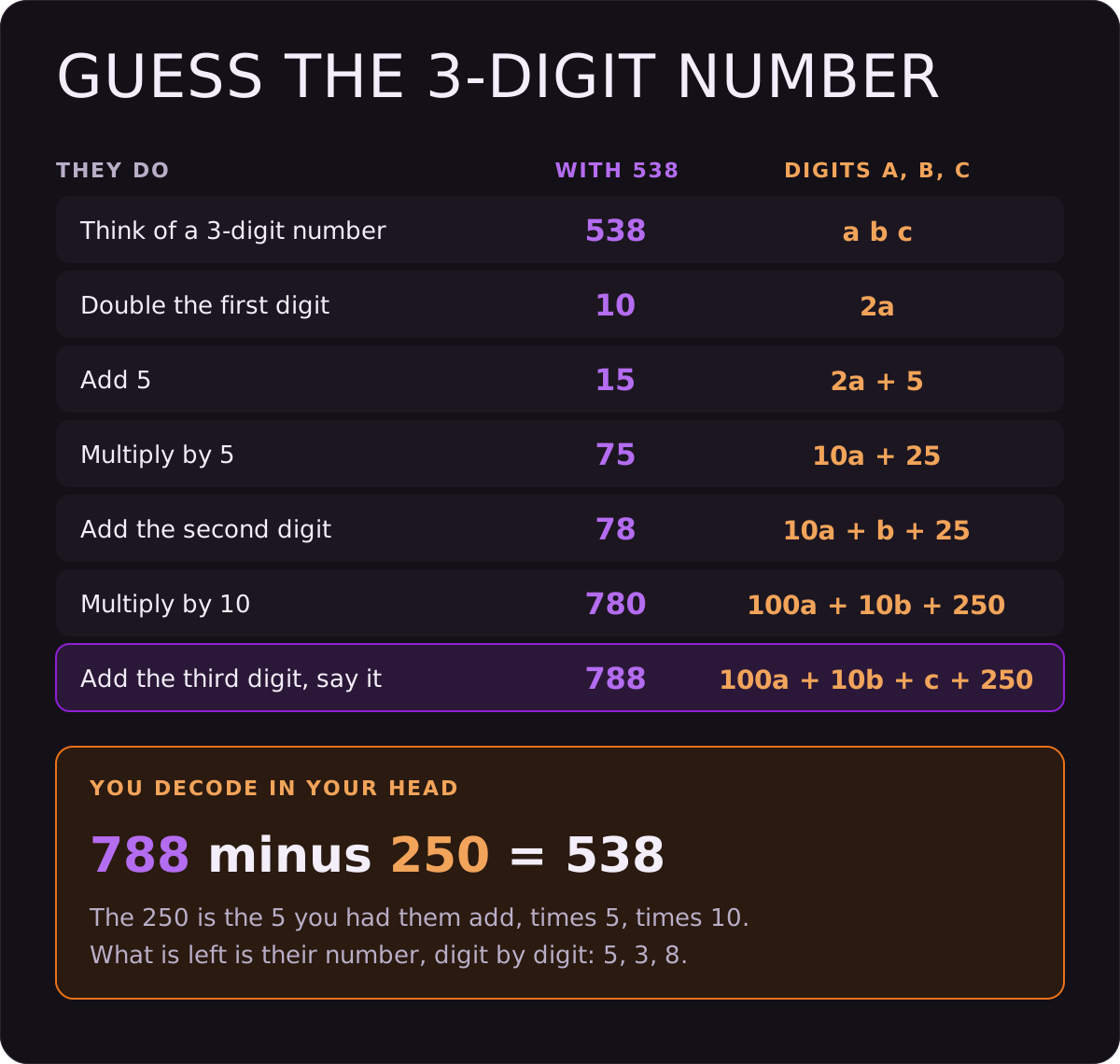
Ask them to think of a three-digit number, for example 538, and to keep it to themselves.
-
The first digit
Ask them to double the first digit (10), add 5 (15), and multiply by 5 (75).
-
The second digit
Ask them to add the second digit (78) and multiply the total by 10 (780).
-
The third digit
Ask them to add the third digit (788) and tell you the result.
-
Decode
Subtract 250 in your head: 788 minus 250 is 538, their number.
Presentation notes
Why it works: if the digits are a, b and c, the steps produce 100a + 10b + c + 250. The 250 comes from the 5 added and multiplied by 5 and then by 10. Present the result as "a random-looking number I need to tune into", pause, then name their number one digit at a time.
Bonus: The 7 × 11 × 13 Stunt
A spectator writes any three-digit number twice in a row to make a six-digit number (538 becomes 538538). You claim it will divide exactly by 7, then by 11, then by 13, with no remainder, and that the final answer will be a number they know well. It is their original number. The reason: writing a three-digit number twice is the same as multiplying it by 1001, and 1001 equals 7 × 11 × 13. It is better as a quick follow-up than as a main routine, because the spectator ends up looking at their own number.
4. The Birthday Reveal
A decoder that feels personal: instead of an abstract number, you reveal the spectator's birthday, or the birthday of anyone they think of.
Routine
The Birthday Reveal
- Level
- Beginner
- Setup
- None
- Running time
- 3 minutes
The effect
A spectator thinks of a birthday, does some arithmetic on a calculator and tells you the result. You tell them the date.
You need
- A calculator or phone for the spectator
-
The month
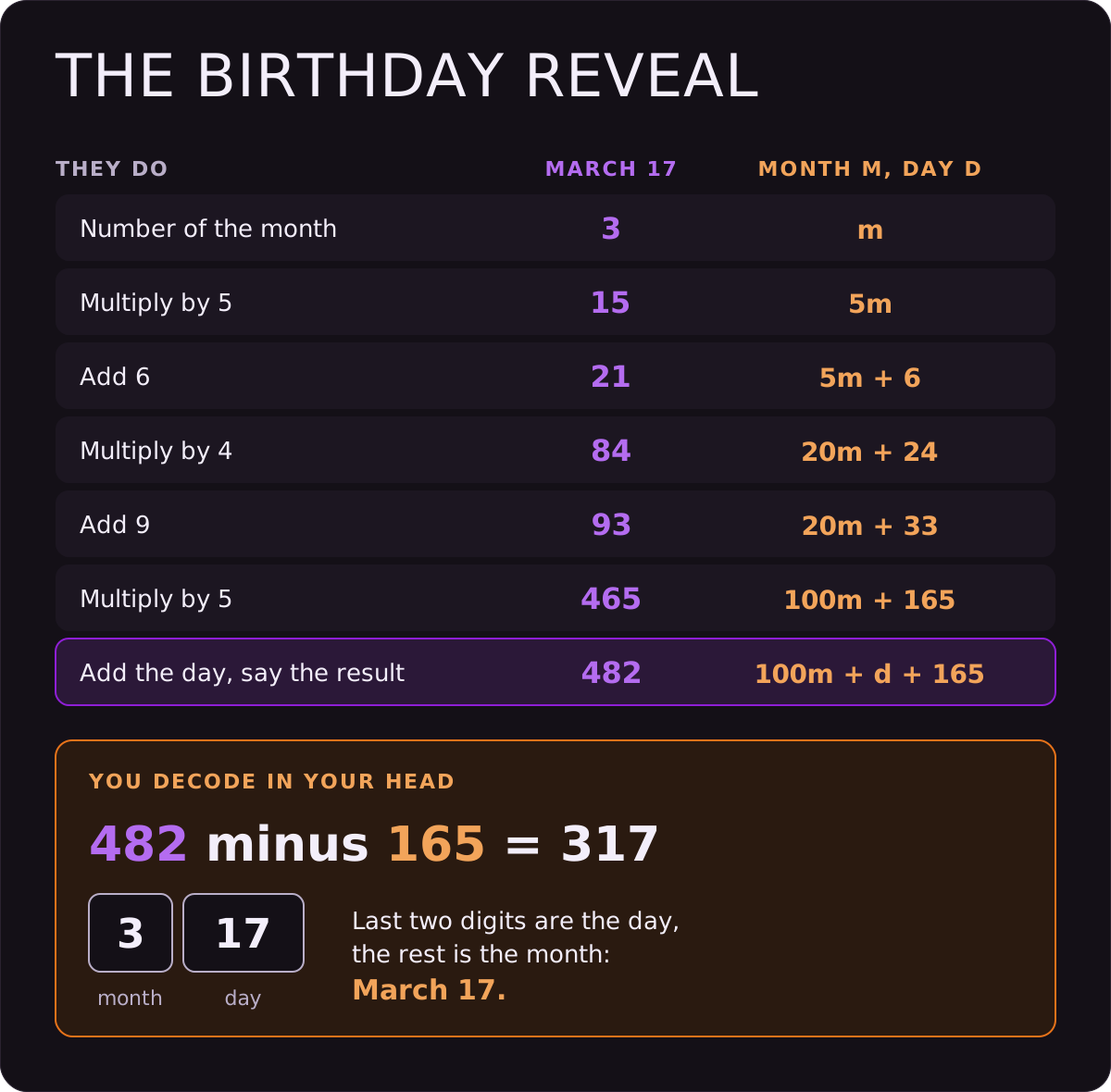
Ask them to take the number of the month (March is 3), multiply it by 5 (15), add 6 (21), and multiply by 4 (84).
-
Scramble
Ask them to add 9 (93) and multiply by 5 (465).
-
The day
Ask them to add the day of the month (for March 17: 482) and tell you the result.
-
Decode
Subtract 165: 482 minus 165 is 317. The last two digits are the day (17) and the rest is the month (3). March 17.
Presentation notes
Why it works: the steps produce 100 × month + day + 165. Ask them to think of a friend's or a family member's birthday rather than their own; it hides the fact that you could have known theirs already, and the reveal becomes a story.
5. The Missing Digit
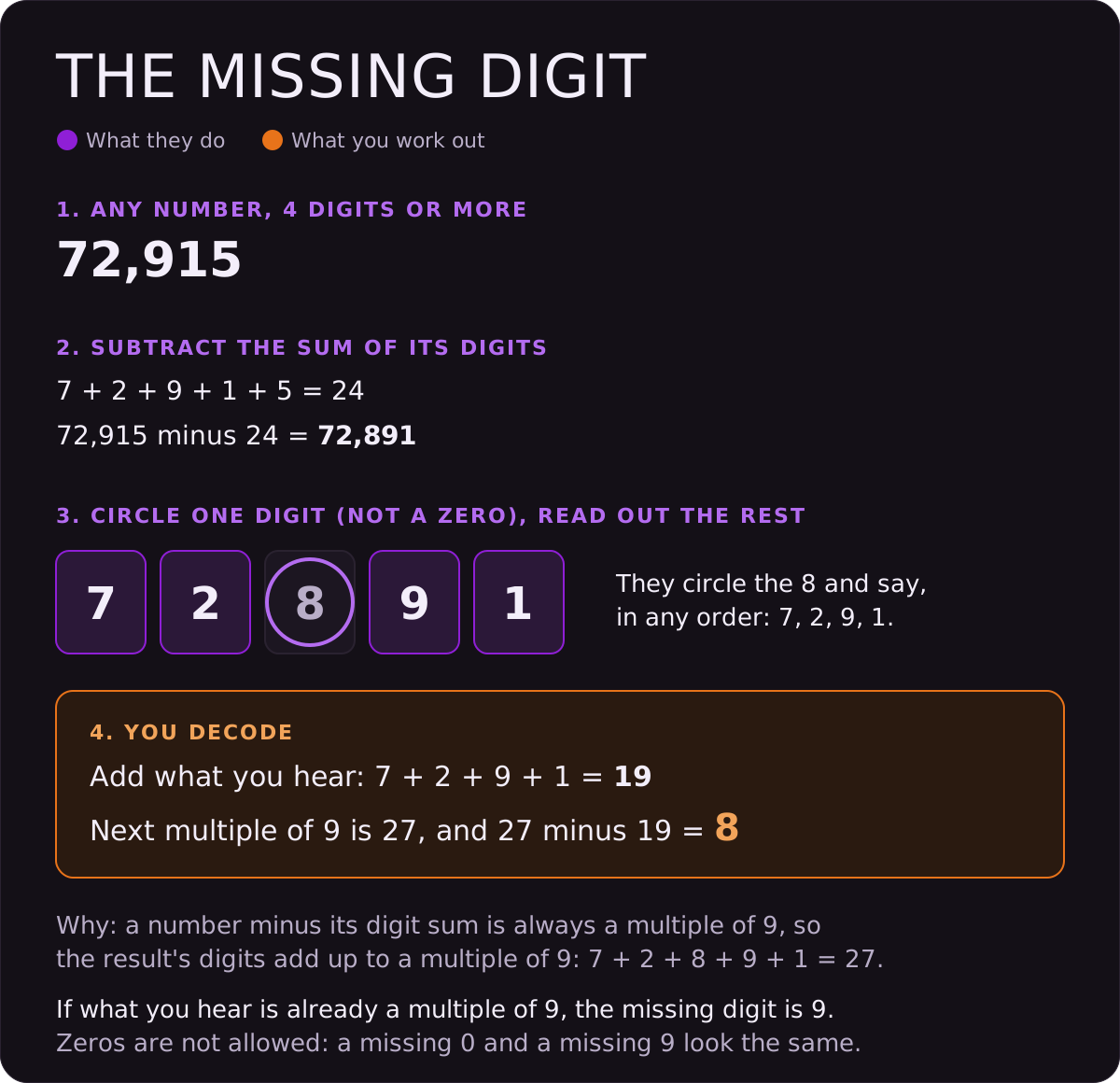
This is the strongest trick on the page and the answer to the question of what the "9 trick" in math is. The spectator creates a long number you never see, crosses out a digit, and you name it.
Routine
The Missing Digit
- Level
- Intermediate
- Setup
- None
- Running time
- 4 minutes
The effect
A spectator writes down any long number, does a calculation, and circles one digit of the result. They read out the other digits in any order, and you name the circled digit.
You need
- A calculator or phone for the spectator
- Paper and pen
-
The number
Ask them to write any number with four or more digits, for example 72,915.
-
Subtract the digit sum
Ask them to add its digits together (7 + 2 + 9 + 1 + 5 = 24) and subtract that from the original number (72,915 minus 24 = 72,891).
-
Circle a digit
Ask them to circle any digit in the result, as long as it is not a zero. Say they circle the 8.
-
Read the rest
Ask them to read out the remaining digits in any order: 7, 2, 9, 1. Add them in your head: 19.
-
Decode
Subtract that total from the next multiple of 9 (27 minus 19 = 8). The circled digit is 8. If the total is already a multiple of 9, the missing digit is 9.
Presentation notes
Why it works: a number minus the sum of its digits is always divisible by 9, and a number is divisible by 9 exactly when its digits add up to a multiple of 9. The missing digit is whatever brings the total back to a multiple of 9. That is why zero is excluded: a missing 0 and a missing 9 would look the same.
6. The Age Cards
A printable classic that has been sold as a novelty for generations. Six cards each hold a list of numbers. The spectator tells you only which cards contain their age (or any number from 1 to 63), and you name it instantly.
How to Make the Cards
Write the numbers 1 to 63 in binary. Card A lists every number whose binary form has a 1 in the units place (1, 3, 5, 7 and so on). Card B lists every number with a 1 in the twos place (2, 3, 6, 7, 10, 11...). Cards C to F do the same for the fours, eights, sixteens and thirty-twos places. Each card begins with its own power of two: 1, 2, 4, 8, 16 and 32.
How to Perform It
Hand over the cards and ask the spectator to give you every card that contains their number. Add up the first number on each of those cards. That total is their number. For a 43-year-old: cards beginning 32, 8, 2 and 1, which add to 43.
Shuffle the numbers on each card so they do not look like a sequence, and the method becomes almost impossible to spot.
How to Present Number Tricks as Mentalism
Hide the Maths in a Story
"Multiply by 9" sounds like homework. "Your favorite number from 1 to 10, now multiply it by the number of planets we had before Pluto was demoted" sounds like a game. Wrap each instruction in a reason: a date that matters, a phone keypad, the number of letters in a name.
Give Them the Calculator
Let the spectator use their own phone and turn your back while they work. Your distance from the numbers is what makes the reveal feel like mind reading, not mental arithmetic.
Mix Numbers With Other Material
One number routine is a highlight; three in a row is a maths lesson. Put a number trick between a card routine from our mind reading card tricks and a reading of a person, and each makes the others stronger. For partner codes, drawing duplications and other ways to seem to know thoughts, see how to read minds, and for a full study plan the guide to learning mentalism sets out what to practice next.
Books for Mathematical Mind Reading
-
Best first book
Mathematics, Magic and Mystery
Martin GardnerBeginner
Martin Gardner's Dover classic on tricks that work by mathematics, from number forces to card principles, explained clearly and cheaply.
-
Go deeper
Persi Diaconis and Ron GrahamIntermediate
Persi Diaconis, a mathematician who performed as a magician in his youth, and Ron Graham explain the ideas behind great self-working tricks, including cyclic stacks and shuffling principles.


Free newsletter
Mentalism, made modern. In your inbox.
Occasional emails from the MentalismPro team: a technique to practice, a routine idea, and the new guides and books worth your time. No spam, unsubscribe any time.