

Tricks & routines
Mind Reading Card Tricks: 5 Mentalism Card Tricks Explained
Classic card principles presented as mind reading, with complete methods and the decks that make card mentalism easier.
 By The MentalismPro TeamUpdated
As an Amazon Associate we earn from qualifying purchases. How we choose products.
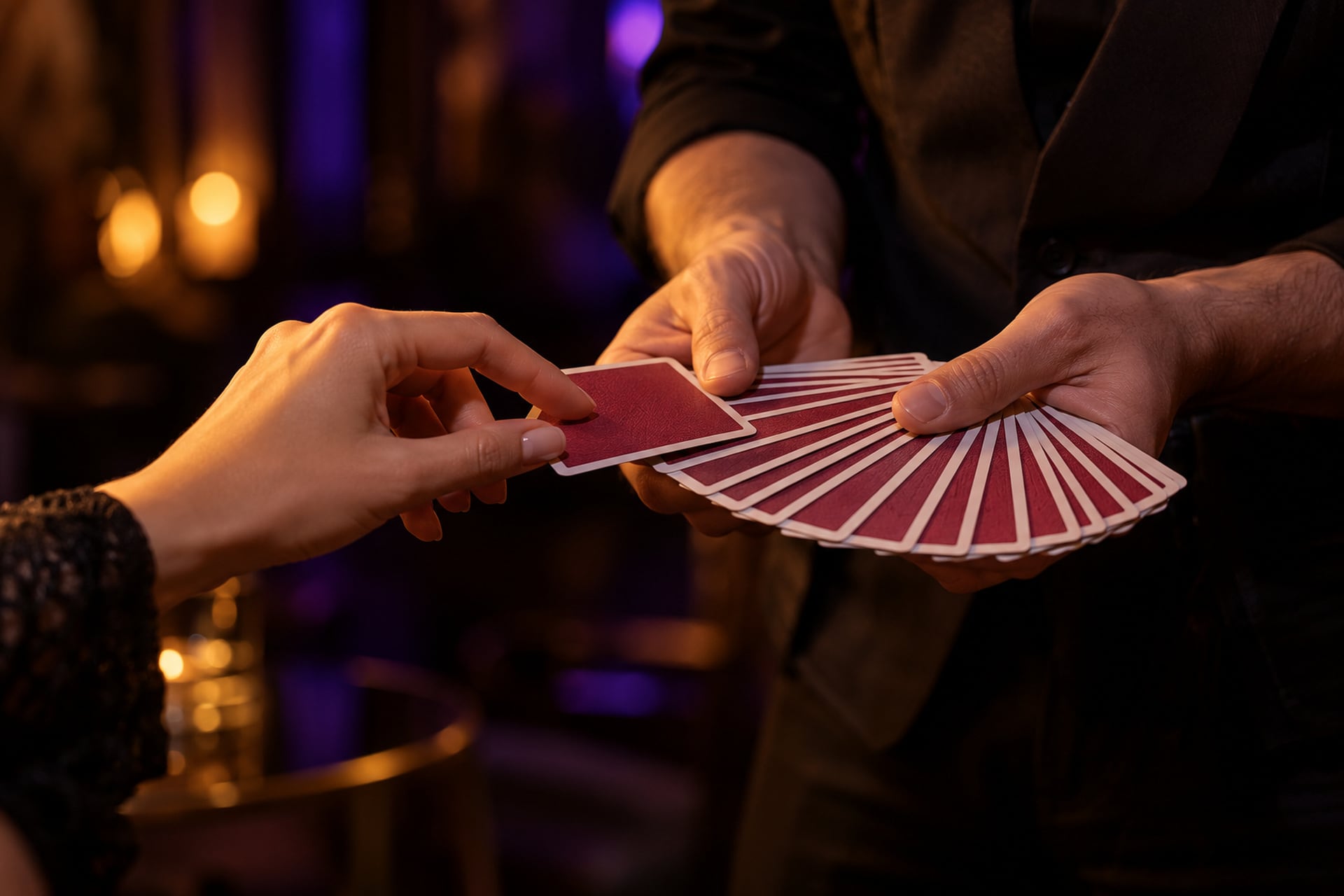
A mind reading card trick is a card trick where the climax is not "is this your card?" but "you're thinking of the seven of hearts". The difference sounds small. In performance it is huge: the spectator never sees you find anything, so the only explanation left is that you somehow knew.
This page teaches five mentalism card tricks with complete methods, from a one-minute key card routine to a full-deck stack published in 1898. All of them use a normal deck and public-domain principles. At the end you will find the special decks and the one book that make card mentalism much easier, explained without giving away their secrets.
What Makes a Card Trick Mentalism
Magicians and mentalists often use the same card principles. What changes is the story. A magician shows a card that appears, changes or travels. A mentalist uses the deck as a menu of 52 thoughts and pretends the cards are only there to give the spectator something to think about.
Three Rules for Card Mentalism
- No flourishes. Fancy shuffles and fans tell the audience you are skilled with cards, which points them straight at the method.
- Name, don't find. Whenever you can, reveal the card by naming it, slowly, color first, then suit, then value.
- Let them hold the cards. The less you touch the deck, the stronger the mind reading feels.
What You Need
One standard poker-size deck in good condition is enough for every routine on this page except You Do As I Do, which needs two decks with different back colors. A two-pack of Bicycle cards covers both.
If you are new to the whole field, start with the main guide to mentalism tricks, which covers no-prop routines like the Clock Trick before you pick up a deck.
Easy Mind Reading Card Tricks
These three routines are self-working or close to it. You can learn each in under an hour; the rest of your time goes into the script.
1. Key Card Mind Reading
The key card principle is the oldest and most useful tool in card magic. You secretly learn one card (the key), and you arrange for the spectator's card to end up right next to it.
Routine
Key Card Mind Reading
- Level
- Beginner
- Setup
- None
- Running time
- 3 minutes
The effect
A spectator chooses a card, loses it in the deck and cuts the cards as often as they like. You glance through the deck "to get a feel for it", hand it back, and name their card while looking only at them.
You need
- One shuffled deck
-
Glimpse the key
Shuffle the deck, then square it and tilt it slightly towards you so you can see the bottom card. Remember it. This is your key card, say the two of clubs.
-
The selection
Spread the cards and let the spectator take one and memorize it. Square the deck and place it face down on the table.
-
Lose the card
Ask them to put their card face down on top of the deck, then cut the deck and complete the cut. Your key, which was on the bottom, now sits directly above their card. They can add more complete cuts: cutting does not separate the two cards (unless a cut falls exactly between them, which is rare).
-
Read the deck
Pick up the deck with the faces towards you and thumb through from the face, saying you are looking for a card that "feels wrong". When you reach the two of clubs, the card you passed just before it is theirs. Keep going a little further so you do not stop on the key.
-
The reveal
Hand the deck back. Look at the spectator, not the cards. Say: "Think of the color. Red. Now the value, it's a high card, a picture card. The queen of hearts."
Presentation notes
If the key is the very first card you see at the face, their card is at the back of the deck. Pretend to read their reactions to get to the answer gradually; it hides the fact that you knew it instantly.
2. The 21-Card Trick as Mind Reading
The 21-card trick goes back at least to the early 1600s, and the French mathematician Joseph Gergonne published the mathematics of the larger 27-card version in 1813. Most people have seen it done as "is this your card?". Presented as mind reading, it becomes a much stronger effect.
Routine
The 21-Card Trick, Mind Reading Version
- Level
- Beginner
- Setup
- None
- Running time
- 5 minutes
The effect
The spectator thinks of one card among 21 dealt face up and only tells you which pile it is in, three times. You put the cards away and name their card.
You need
- 21 cards from any deck
-
The deal
Deal 21 cards face up into three columns of seven, dealing across the rows (one card to each column, then the next row). Ask the spectator to think of any one card and tell you only which column it is in.
-
Gather
Pick up the columns one at a time, always putting the named column between the other two.
-
Repeat twice
Deal again in the same way, ask for the column, gather it in the middle. Do this a total of three times.
-
Count to eleven
After the third gathering, their card is the 11th from the top of the packet. As you square the cards, note it quietly by counting from the top or the face.
-
The reveal
Put the packet in your pocket or hand it to someone else. Ask the spectator to picture their card on a blank wall, and name it slowly.
Presentation notes
The mathematics is visible to a sharp spectator, so the presentation matters: say the columns help you narrow down the "frequency" of their thought. Do it once per audience.
3. The Cross-Cut Force Prediction
A force makes someone choose a card you decided in advance. The cross-cut force is the cleanest beginner force because the spectator does the cutting and you barely touch the deck.
Routine
The Cross-Cut Force Prediction
- Level
- Beginner
- Setup
- 1 minute
- Running time
- 3 minutes
The effect
You write a prediction and leave it face down on the table. The spectator cuts the deck anywhere and takes the card at the cut. It matches your prediction.
You need
- One deck
- A business card or slip of paper
- A pen
-
Know the top card
Before you start, note the top card of the deck (for example the five of spades). Write "Five of spades" on the business card and place it face down.
-
The cut
Ask the spectator to cut off any amount of cards and place them on the table. Pick up the bottom portion and place it across the cut portion, crosswise, to "mark the cut".
-
Time misdirection
Now talk for twenty or thirty seconds: about the prediction, about free choice, about how they could have cut anywhere. This pause is the method. When you return to the cards, nobody remembers which half was which.
-
The card at the cut
Lift the upper (crosswise) packet and ask them to take the top card of the lower packet, the card "they cut to". It is the original top card, the five of spades.
-
The reveal
Ask them to turn over their card, then the prediction.
Presentation notes
The force feels fair only if you never hurry. Give the spectator the prediction to hold during the pause, which gives them something to think about and fills the gap naturally.
Stronger Mentalism Card Tricks
These two routines take more preparation and practice. In exchange, they produce the kind of reaction that people describe to friends days later.
4. You Do As I Do
A two-deck classic built on the key card. You and the spectator each choose a card from separate decks, and the two choices turn out to be identical. Presented as a test of how closely two minds can align, it is one of the best card routines for a seated audience.
Routine
You Do As I Do
- Level
- Intermediate
- Setup
- None
- Running time
- 5 minutes
The effect
You and a spectator each shuffle a deck, swap decks, and each secretly choose a card. Both cards are placed face down. When they are turned over, both of you picked the same card.
You need
- Two decks with different back colors
-
Shuffle and glimpse
Hand the spectator the red deck and keep the blue one. Both shuffle. As you square your deck, glimpse its bottom card. This is your key.
-
Swap
Swap decks. Your key card is now at the bottom of the deck the spectator holds.
-
Choose and lose
Say: "Do exactly as I do." Each of you spreads the deck in your hands, removes any card and memorizes it, puts it on top of the deck, and gives the deck a complete cut. You only pretend to remember your card. Their card now sits directly below your key in their face-down deck.
-
Swap and find
Swap decks again. Each of you looks through the deck you now hold, faces towards you, and removes the card you chose. Thumbing through from the face, you find your key; the card you passed just before it is theirs. Remove that card and place it face down next to theirs.
-
The reveal
Count to three and turn the cards over together. They match.
Presentation notes
Insist the spectator keeps their card secret until the end. If they show you, the routine collapses into a find. Use the theme of synchronicity: two people, two decks, one thought.
5. Naming a Cut Card With the Si Stebbins Stack
The Si Stebbins stack was published around 1898 by the performer known as Si Stebbins (William Henry Coffrin). It arranges the deck so that each card is three values higher than the one before it, with the suits in a fixed rotation: clubs, hearts, spades, diamonds (remembered as CHaSeD). Because the order is cyclic, any number of complete cuts leaves it intact, and knowing one card tells you the next.
The Stack
Start with the ace of clubs and add three each time, cycling through the suits. Jacks count as 11, queens 12, kings 13, and anything above 13 wraps around (king plus 3 is 3). The first cards are: A♣, 4♥, 7♠, 10♦, K♣, 3♥, 6♠, 9♦, Q♣, 2♥, 5♠, 8♦, J♣, A♥, and so on through all 52 cards.
Routine
The Cut-Card Reading
- Level
- Advanced
- Setup
- 15 minutes to set the deck
- Running time
- 3 minutes
The effect
A spectator cuts the deck as many times as they want and takes the top card without showing anyone. You never see its face, yet you name it.
You need
- One deck arranged in Si Stebbins order
-
Set the deck
Arrange the deck in Si Stebbins order before the performance. Do not shuffle it in front of anyone. Complete cuts are fine.
-
The cuts
Hand the spectator the deck and invite them to give it several complete cuts. Then ask them to take the top card and hold it against their chest.
-
The glimpse
Take the deck back and glimpse its bottom card, for example while tapping the deck on the table to square it, or while placing it in the card box. Say the bottom card is the 8 of diamonds.
-
The calculation
Add three to the value and move to the next suit in CHaSeD order. Eight plus three is jack; after diamonds comes clubs. Their card is the jack of clubs.
-
The reveal
Build the reveal slowly: "It's a dark card. A court card. The jack of clubs."
Presentation notes
A mixed-looking stack is the strength of Si Stebbins: a casual spread shows no obvious order. You can repeat the effect by having the card replaced on top and the deck cut again. For a deeper look at stacks and other mathematical principles, the book Magical Mathematics by Persi Diaconis and Ron Graham is the standard reference.
Card Props That Do the Work
Some of the strongest mind reading card tricks rely on specially made decks. They are mass-produced classics, widely sold, and they let a beginner perform a professional-strength effect on the first day. We describe what each one does, not how it works: the secret is what you pay for.
The Invisible Deck
A spectator names any card at all, with total freedom. The deck, which has been in its box on the table from the start, is spread: every card is face down except one, and it is the card they named. It is widely considered one of the best mentalism card tricks ever sold.
The Brainwave Deck
The effect is similar, with an extra punch: the named card is the only one reversed in the deck, and its back is a different color from every other card.
ESP Cards
The five-symbol Zener deck turns card mentalism into a telepathy experiment. The guide to ESP cards and how to use them covers the history, how to run a fair test and routines that use them.
For more props beyond cards, including the nail writer and the peek wallet, see our list of the best mentalism tricks to buy.
What to Buy for Card Mentalism
A starter set that covers every routine on this page and two classic trick decks.
-
1Practice decks
Bicycle Playing Cards, 2 Pack (Red and Blue)
Two standard poker-size decks with different back colors, exactly what You Do As I Do requires.
-
2Best first trick deck
Invisible Deck (Bicycle stock)
The classic any-card-named effect, made with genuine Bicycle cards and supplied with instructions.
-
3Second trick deck
Brainwave Deck (Bicycle Rider Back)
The named card is the only reversed card and has a different back color; a strong follow-up once the Invisible Deck is familiar.
-
4Book
Self-Working Card Tricks by Karl Fulves
A low-cost Dover classic of 72 self-working tricks, many of them easy to present as mind reading.


How to Present Mind Reading Card Tricks
Reveal in Stages
Color, then suit, then value. Each stage that lands builds tension and gives you room to adjust if you are working with partial information, as in the key card routine.
One Card Routine per Set
Cards remind people of magic. In a mentalism set, use one card routine, place it in the middle, and surround it with routines that use words, drawings or numbers. The number mind reading tricks make good partners because they need no props at all.
Practice the Script, Not Just the Moves
Write down what you say at every step and rehearse it aloud. Most beginners learn the method perfectly and then improvise the words, which is where card tricks start to look like card tricks. For a structured way to build those skills, the plan to learn mentalism sets out what to practice and in which order.
Free newsletter
Mentalism, made modern. In your inbox.
Occasional emails from the MentalismPro team: a technique to practice, a routine idea, and the new guides and books worth your time. No spam, unsubscribe any time.