

Props & tricks
ESP Cards: The Zener Deck Explained, Tested and Performed
Where the five symbols came from, what scores mean, how to run an honest test, and how mentalists use the deck on stage.
 By The MentalismPro TeamUpdated
As an Amazon Associate we earn from qualifying purchases. How we choose products.
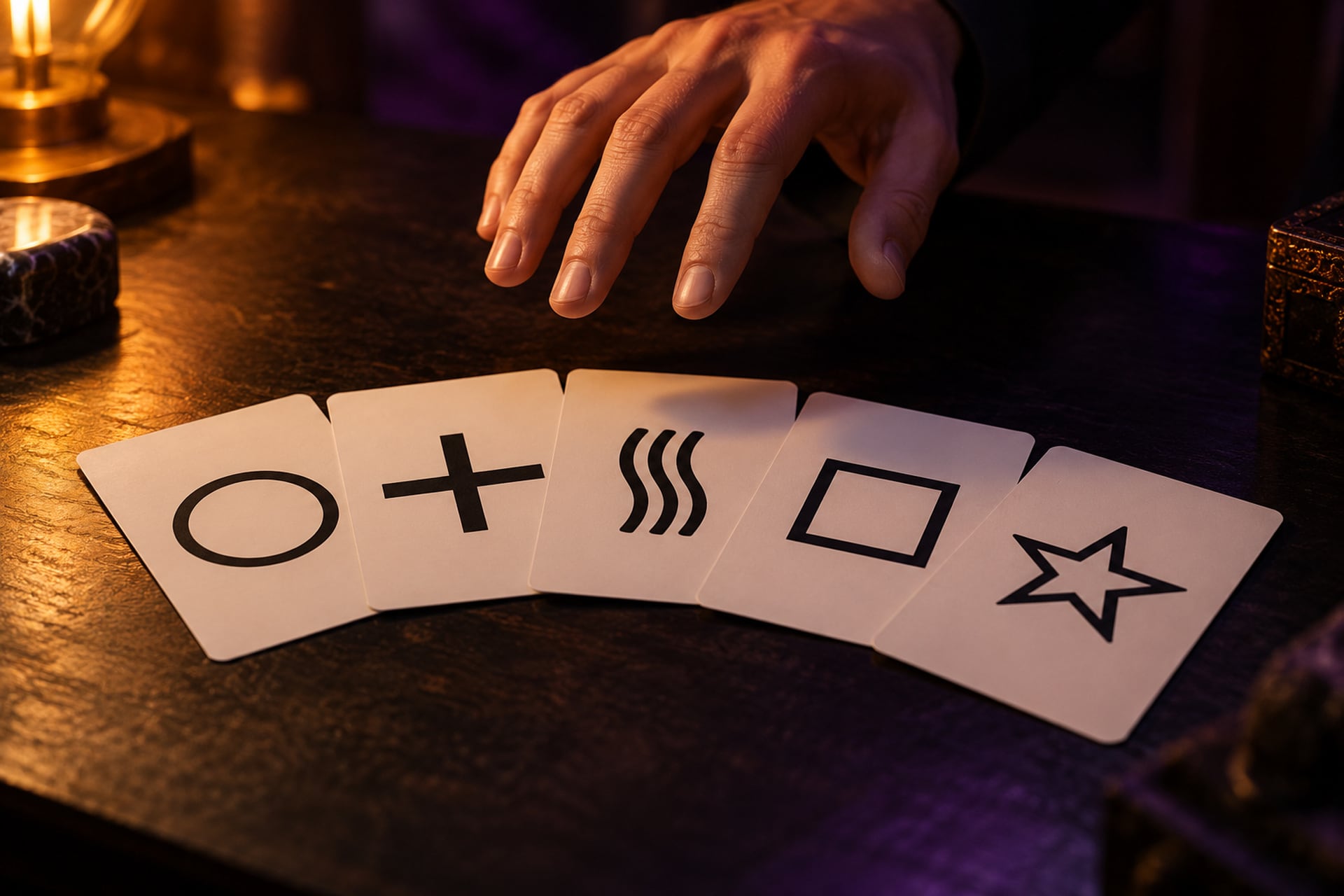
ESP cards, also called Zener cards, are a deck of 25 cards printed with five simple symbols: a circle, a cross, three wavy lines, a square and a star. They were designed in the early 1930s at Duke University to test whether people could guess unseen cards better than chance. Nearly a century later they are a party game, a classroom statistics lesson and one of the favorite props of stage mentalists.
This guide covers the history of the deck, what the famous experiments found, how to run a fair ESP card test at home, two routines you can perform with them, and which decks to buy for testing or for performing.

Best for honest tests
Zener-Style Unmarked ESP Testing Cards
A plain 25-card set with the five standard symbols, sold explicitly as unmarked and not a magic trick. That is exactly what you want when the point is a fair test rather than a performance.
-
Best for groups
Six 25-card decks in poker size, enough for a classroom or several pairs at a party.
-
Best for performing
A beginner kit of performer's ESP cards and prediction props for telepathy-style routines.

What Are ESP Cards?
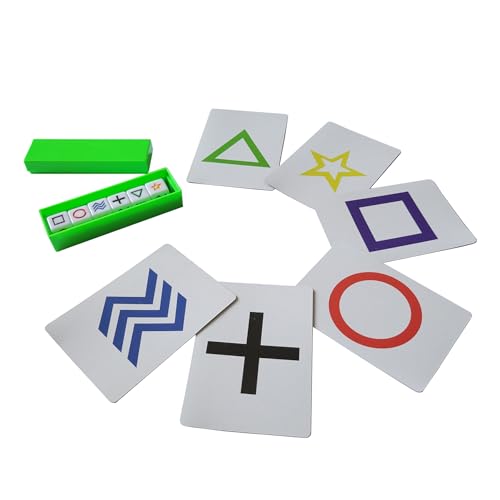
ESP stands for extrasensory perception: the claimed ability to gain information without the known senses. ESP cards were created to measure that claim in a laboratory, with simple symbols that are easy to tell apart and a deck small enough to work through in a few minutes.
The Five Zener Symbols
| Symbol | Cards per deck | Chance of a correct guess |
|---|---|---|
| Circle | 5 | 1 in 5 |
| Cross (plus sign) | 5 | 1 in 5 |
| Three wavy lines | 5 | 1 in 5 |
| Square | 5 | 1 in 5 |
| Five-pointed star | 5 | 1 in 5 |
According to accounts of the original design, the earliest decks used a rectangle that was later changed to a square. The shapes are simple geometric figures that are easy to tell apart at a glance, which keeps a run of 25 guesses quick.
Karl Zener and J. B. Rhine at Duke
The deck is named after Karl Zener (1903 to 1964), a perceptual psychologist at Duke University, who designed it with the parapsychologist J. B. Rhine in the early 1930s. Rhine used the cards in a long series of card-guessing experiments and published the results in 1934 in a book titled Extra-Sensory Perception, which was widely read for decades and made the cards famous.
From the Lab to Ghostbusters
Zener cards reached a mass audience through films and television, most famously the opening scene of Ghostbusters (1984), in which Bill Murray's character runs a far from fair ESP card test on two students. Today they are sold as games, classroom kits and mentalism props.
What the ESP Card Experiments Found
Rhine's laboratory reported subjects who scored well above chance. The best-known series, run in 1933 and 1934, involved a subject named Hubert Pearce, who was reported to average about 30 percent correct, against the 20 percent expected by chance, while the research assistant J. G. Pratt handled the cards in a different building on campus.
Why the Results Did Not Hold Up
Critics found several ways information could leak or results could be skewed without any extrasensory ability:
- Poor shuffling by hand can leave patterns that make the order easier to predict.
- The cards themselves: symbols could sometimes be read from the back of the cards through slight indentations on the backs.
- Sensory cues from the experimenter, such as facial expressions or breathing, when sender and guesser were in the same room.
- Selective reporting of good runs over bad ones.
When Rhine tightened his controls, the high-scoring subjects disappeared. The psychologist James Alcock has noted that parapsychologists no longer run card-guessing studies. The mainstream scientific position is that ESP has not been demonstrated. For a wider look at the question, read is mentalism real, and for how performers create the illusion on stage, how mentalism works.
How to Run a Fair ESP Card Test
Running your own test is a good lesson in probability and in how easily results get contaminated. These steps remove the most common leaks.
A Fair Zener Test in Seven Steps
-
Use plain cards
Use an unmarked deck and check the backs under a bright light before you begin. Magic decks are designed to help a performer and spoil a real test.
-
Separate sender and guesser
Put the sender and the guesser in different rooms, or at least behind a screen with no line of sight to each other or to any reflective surface.
-
Randomize properly
Shuffle thoroughly, or better, use a random number generator to set the order of the 25 targets and write it down before the run.
-
Record every guess
The guesser writes down each guess in order on a numbered sheet. No feedback between cards: knowing which guesses were right changes later guesses.
-
Score at the end
Compare the guess sheet with the target list only after all 25 guesses are complete. Count the matches.
-
Count every run
Decide the number of runs in advance and include every one in the result, the bad as well as the good.
-
Compare with chance
Use the table below to judge whether a score is unusual. One high run is not evidence; a consistent pattern across many controlled runs would be.
What Your Score Means
With five symbols, each guess has a 1 in 5 chance of being right, so the expected score is 5 out of 25. The probabilities below follow from the binomial distribution and assume pure guessing.
| Score out of 25 | Chance of scoring this or higher by luck | Roughly |
|---|---|---|
| 6 or more | 38% | 2 runs in 5 |
| 7 or more | 22% | 1 run in 5 |
| 8 or more | 11% | 1 run in 9 |
| 9 or more | 4.7% | 1 run in 21 |
| 10 or more | 1.7% | 1 run in 58 |
| 12 or more | 0.15% | 1 run in 670 |
In other words, if twenty friends each do one run, someone will probably score 9 or more by chance alone. That is the single most useful thing an ESP card test teaches.
Mentalism Tricks With ESP Cards
For a performer, ESP cards are a gift: the audience already knows what they are, so a routine needs no explanation. Present them honestly as entertainment, a recreation of the old experiments where the outcome is a performance, not a scientific result. These two routines work with any 25-card deck.
1. The Symbol Prediction
Routine
The Symbol Prediction
- Level
- Beginner
- Setup
- 1 minute
- Running time
- 3 minutes
The effect
You seal a prediction in an envelope. A spectator cuts the ESP deck anywhere and takes the symbol at the cut. It matches the prediction.
You need
- A 25-card ESP deck
- An envelope or folded card with your prediction
-
Prepare
Note the top card of the deck (say, the star), draw a star on a card and seal it in an envelope. Place the envelope in view.
-
The cut
Ask the spectator to cut off any number of cards and put them on the table. Place the remaining cards crosswise on top of them to mark the cut.
-
The pause
Talk for half a minute about Rhine's experiments and the odds of one in five. Hand the spectator the envelope to hold.
-
The selection
Lift the crosswise cards and ask the spectator to take the top card of the lower packet, the symbol "at the cut". It is the original top card.
-
The reveal
Have them open the envelope first, then turn over their card.
Presentation notes
This is the cross-cut force, also taught on our mind reading card tricks page with a normal deck. With ESP cards, the theme of the deck does half your presentation for you.
2. The Two-Person Telepathy Test
A partner routine that recreates a laboratory test, with a result no laboratory ever produced: five correct out of five.
Routine
The Two-Person Telepathy Test
- Level
- Intermediate
- Setup
- 30 minutes of rehearsal with your partner
- Running time
- 5 minutes
The effect
Your partner sits blindfolded with their back to the audience. A spectator shows you one ESP card at a time. You concentrate, and your partner names each symbol correctly.
You need
- An ESP deck
- A partner
- A blindfold or a chair facing away
-
Agree the code
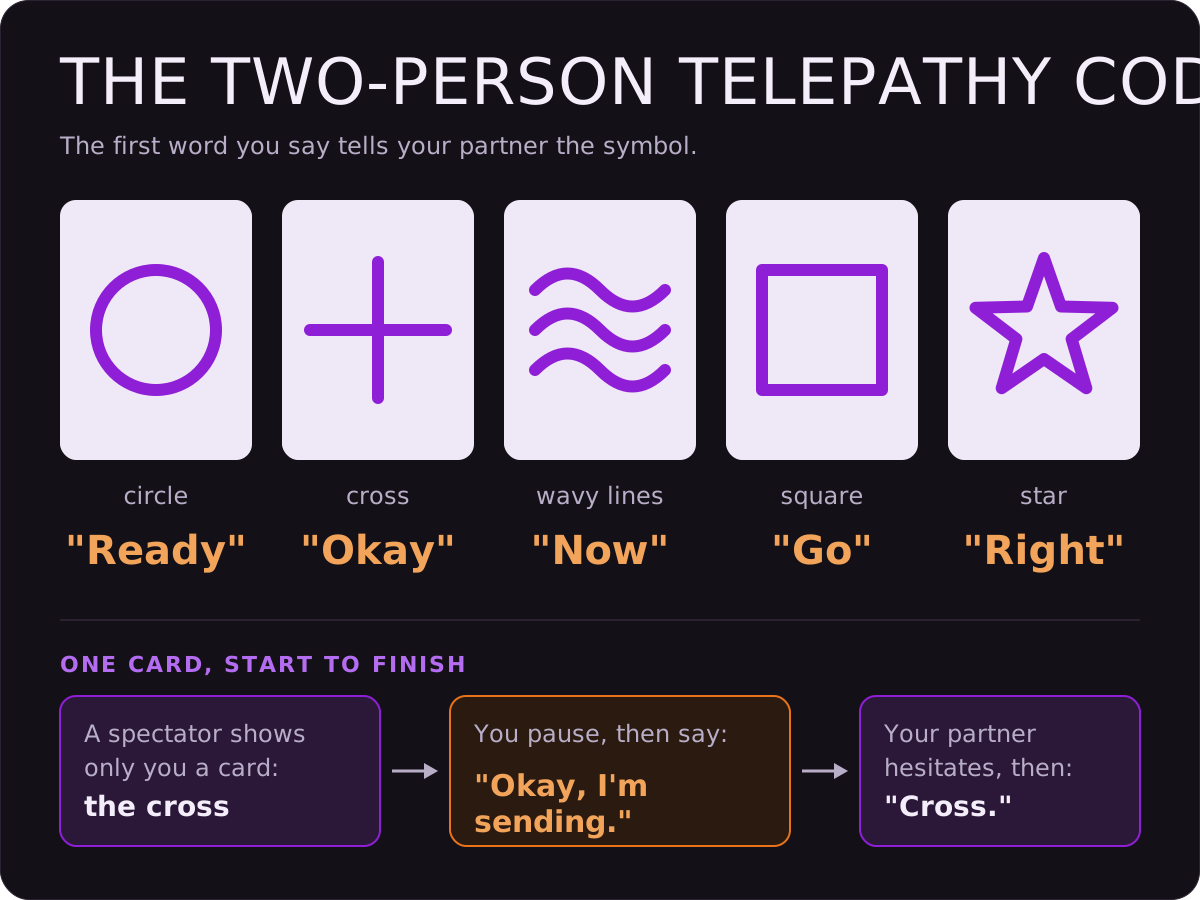
Assign a cue word to each symbol: "Ready" for circle, "Okay" for cross, "Now" for wavy lines, "Go" for square and "Right" for star. Practice until you both respond without thinking.
-
Set the scene
Explain the original Zener experiments and their odds. Blindfold your partner and turn their chair away from the room.
-
Each card
A spectator shuffles, takes a card and shows it only to you. You look at it, pause, and begin the attempt with the cue word: "Okay, I'm sending." Your partner hesitates, then names the symbol.
-
Five runs
Repeat for five cards. Vary your pauses and, now and then, have your partner give a wrong first impression and correct it, which looks more like effort and less like a code.
Presentation notes
Verbal codes are among the oldest methods of two-person mentalism. Keep each cue natural and short so the audience never notices that you always start with a word. If someone suspects your voice, switch to a silent run: the spectator shows you the card and your partner answers after a count of your choice, using a timing code you agreed for backup.
Commercial ESP Routines
Magic shops sell ESP decks and gimmicks built for performers, from marked decks to forcing decks and self-contained routines. We do not explain how they work, but the magic ESP kit in our picks below is a sensible starting point. For more props that create the same kind of mind reading effect, see the best mentalism tricks to buy, and for no-prop routines start with our guide to mentalism tricks.
The Best ESP Cards to Buy
The right deck depends on whether you want to test, teach or perform. The key question is whether the cards are plain or made for magic.
For Testing: Plain and Unmarked
An honest test needs cards that cannot be read from the back. Look for listings that say unmarked, check the backs under a bright light, and avoid magic versions.
For Classrooms and Parties: Multiple Decks
A multi-deck pack lets several pairs run tests at once and compare their scores against the chance table, which is a memorable way to teach probability.
For Performing: A Magic ESP Set
Performer's ESP cards are designed to help you, so they make routines easier and more reliable. Present them as entertainment, not as a scientific test.
Our ESP Card Picks
Four decks for the four jobs ESP cards do.
-
1Best for honest tests
Zener-Style Unmarked ESP Testing Cards
A single plain deck, sold as unmarked and not a magic trick. The right choice for the protocol on this page.
-
2Best for groups
Six 25-card decks in standard poker size, enough for a classroom, a workshop or several pairs at once.
-
3Best boxed edition
Zener Cards (Llewellyn Publications)
A boxed Zener deck from Llewellyn Publications, credited to Pierluca Zizzi; a more giftable option for anyone curious about the history.
-
4Best for performing
Performer's ESP cards plus prediction props for telepathy-style routines. For entertainment only, never for a real test.

Free newsletter
Mentalism, made modern. In your inbox.
Occasional emails from the MentalismPro team: a technique to practice, a routine idea, and the new guides and books worth your time. No spam, unsubscribe any time.