

Technique
Cold Reading: What It Is and How It Works
The techniques behind readings that feel impossibly personal, how to spot them, and how mentalists use them honestly as entertainment.
 By The MentalismPro TeamUpdated
As an Amazon Associate we earn from qualifying purchases. How we choose products.

Cold reading is the set of techniques that lets a reader tell a stranger things that seem personal, specific and true, without any prior knowledge of that person. Psychics, palm readers and astrologers have relied on it for centuries, often without admitting it, and some without realizing it. Mentalists use the same tools openly, as part of a performance.
This guide explains what cold reading is, where it sits next to hot reading and warm reading, the main techniques behind a convincing reading, how to tell when someone is cold reading you, and how to practice it as an entertainer without ever misleading anyone. It is one of the core tools covered in our guide to mentalism techniques.
What Is Cold Reading?
The word "cold" means the reader walks in with no information. Everything in the reading is built in the moment, from three raw materials: what is true of almost everyone, what can be inferred from what is visible, and what the person reveals through their answers and body language. A skilled reader blends the three so smoothly that the listener cannot tell where one ends and the next begins.
A reading usually opens with broad statements, moves to guesses that are likely to land, and then follows the person's reactions. When a guess gets a nod, the reader builds on it. When it gets a blank look, the reader reframes it or moves on so quickly that the miss is forgotten. By the end, the listener often remembers a stream of accurate, specific revelations, and very little of what was actually said.
Cold Reading in Psychology
Psychologists study cold reading because it shows how people judge whether a description fits them. Two effects do most of the work. The first is the Barnum effect, the tendency to rate vague, general personality descriptions as highly accurate for ourselves. The second is selective memory, sometimes described as confirmation bias: we notice and remember what confirms the reading and quietly discard what does not.
On top of that, the listener is cooperating. Someone who sits down for a reading wants it to make sense, so they search their own life for a match to every statement. The reader supplies the outline; the listener supplies the detail, then credits the reader with knowing it.
Where the Idea Comes From
The best known account comes from psychologist Ray Hyman, who read palms for money as a young man and came to believe palmistry worked. Hyman has described how the mentalist Stanley Jaks persuaded him to try an experiment: tell a client the opposite of what the lines on her palm suggested. She was just as impressed as earlier clients, and later clients were too. Hyman concluded that the client's reaction had little to do with the palm and everything to do with the way the reading was delivered. He went on to become a psychology professor, and his essay on cold reading became one of the most reprinted pieces in the history of the Skeptical Inquirer, according to his colleague James Alcock.
Cold Reading vs Hot Reading vs Warm Reading
The three terms are often confused. They describe where the reader's information comes from, and they are often combined in a single performance.
| Type | Where the information comes from | Typical example |
|---|---|---|
| Cold reading | General statements, educated guesses and live feedback | A palm reader meeting a walk-in client |
| Warm reading | Statements that are true of almost anyone in a known situation | Telling a grieving person they keep an item that belonged to the deceased |
| Hot reading | Information gathered in advance, from research, assistants or overheard conversation | A stage "healer" naming an audience member's illness |
Hot Reading
Hot reading is not a psychological technique at all; it is research presented as revelation. The most famous exposure is the case of the televangelist Peter Popoff. In 1986, James Randi and his associate Steve Shaw (the mentalist known as Banachek), with electronics expert Alexander Jason, showed that Popoff's wife was reading details from audience members' prayer cards over a radio transmitter while Popoff listened through an earpiece. Recordings of the transmissions were played on The Tonight Show with Johnny Carson.
In entertainment, information gathered in advance can be a legitimate part of a show, as long as the show is presented as entertainment. The line is crossed when it is used to convince people that a reader has supernatural access to their lives, especially for money.
Warm Reading
Warm reading uses the fact that certain situations produce predictable experiences. Someone who has lost a parent very likely kept a photograph, a piece of jewelry or a letter. Someone asking about their career is probably facing a decision. The statements sound specific, but they are close to certain in context. Readers who work with grief are where warm reading does the most harm, which is why ethical mentalists refuse to do readings for people in mourning.
Cold Reading Techniques
Every reader develops a personal style, but the same handful of techniques appears again and again in the literature. Ian Rowland's The Full Facts Book of Cold Reading catalogs dozens of them under memorable names; the categories below are the general principles most writers agree on.
Barnum Statements
A Barnum statement sounds personal but fits nearly everyone: "You can be very sociable, but there are times when you need to be alone to recharge." These statements are the foundation of a reading because they almost never miss. The full psychology behind them is on our page about why vague descriptions feel personal.
Statements That Cover Both Sides
Rowland calls one family of these the "Rainbow Ruse": a statement that credits the person with a trait and its opposite. "You are generally a patient person, but when something really matters to you, you can become surprisingly impatient." Whatever the listener's personality, it fits, and it feels insightful because it seems to recognize their complexity.
High-Probability Guesses
Some guesses are far more likely than they sound. Many people have a scar on the knee, a box of old photographs they never sorted, or a name that was shortened or changed in childhood. A reader with a list of these can fire off apparently specific details with a high hit rate. Age, clothing, hands, posture and jewelry narrow the field further.
Fishing and the Disguised Question
Much of a reading is made of questions phrased as statements. "I'm sensing some connection with the month of March" invites the listener to supply a birthday, an anniversary or a loss. When they answer, the reader confirms it as if it had been known all along. Listen to a recording of a reading afterward and count how much information came from the client.
Reading the Feedback
Cold reading is a conversation. A slight nod, a lean forward, a change in breathing or a pause before "no" tells the reader whether to push a line or drop it. This is where cold reading overlaps with ordinary people-reading skills, covered in our guide to reading people and body language.
Turning Misses into Hits
Good readers rarely accept a miss. A wrong detail becomes something that will happen later, something that belongs to a relative, or something the listener has forgotten. "Keep that in mind; it may make sense next week." The miss quietly disappears, while every hit gets emphasized and repeated.
Routine
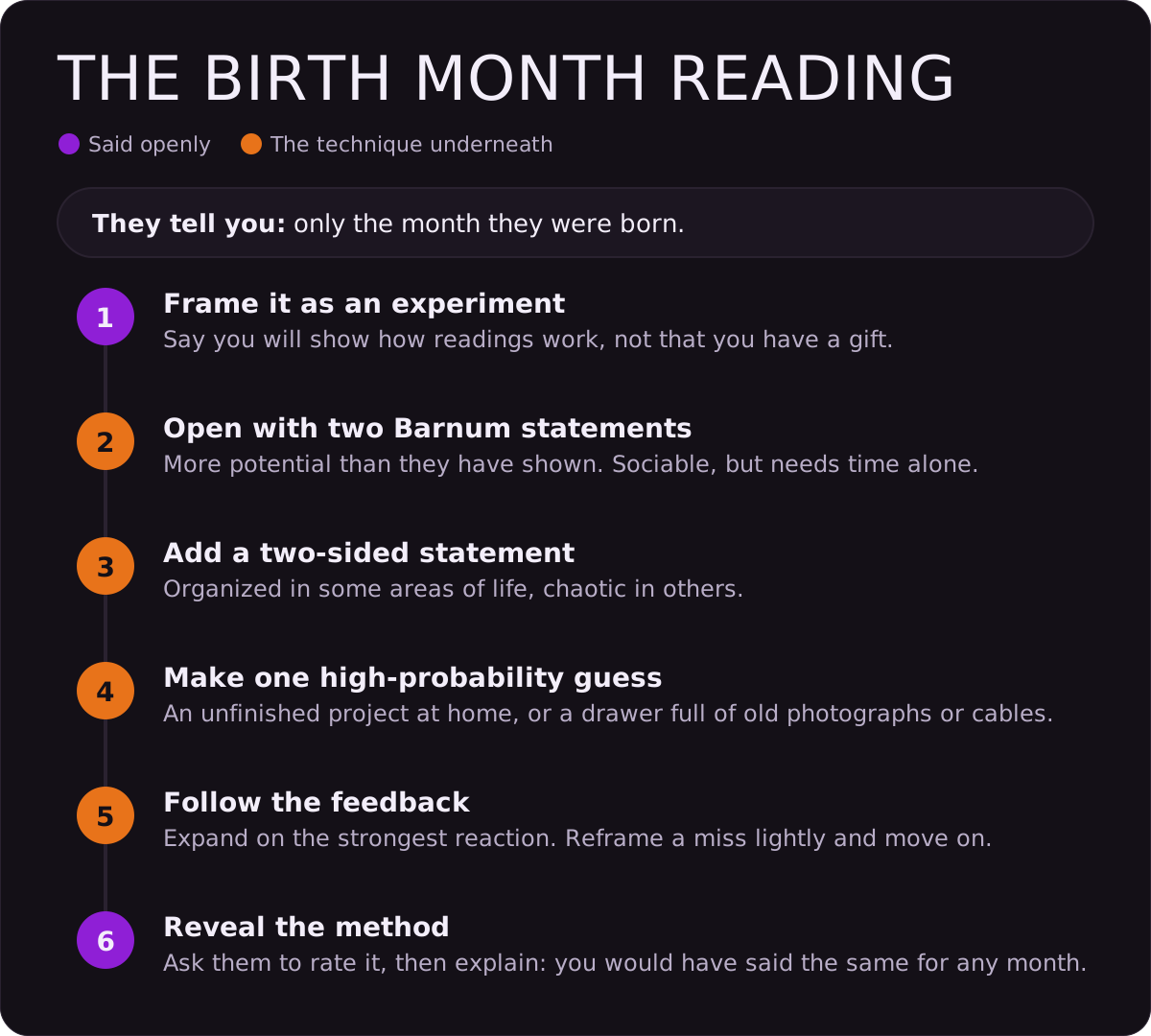
Practice Routine: The Birth Month Reading
- Level
- Beginner
- Setup
- 30 minutes to learn the script
- Running time
- 3 to 5 minutes
The effect
A friend tells you only the month they were born. From that alone, you give a short character reading that they find surprisingly accurate. Afterward, you explain exactly how it was done, which is often the most memorable part.
You need
- Nothing, or a notepad if you prefer to jot notes
-
Frame it as an experiment
Say up front that you are going to demonstrate how readings work, not that you have a gift. "Psychics say they can tell a lot from your birth month. Let me show you what that sounds like."
-
Open with two Barnum statements
Use statements that fit almost anyone: one about having more potential than they have shown, and one about being sociable but needing time alone. Watch their face as you speak.
-
Add a two-sided statement
Credit them with a trait and its opposite, such as being organized in some areas of life and chaotic in others. Most people will nod at this.
-
Make one high-probability guess
Offer one specific-sounding detail that applies to many people, such as an unfinished project at home or a drawer full of old photographs or cables.
-
Follow the feedback
Whatever got the strongest reaction, expand on it in general terms. If something missed, reframe it lightly and move on.
-
Reveal the method
Ask them to rate the reading, then explain what you did. Point out that you would have said the same things for any month. The surprise turns into a conversation about psychology.
Presentation notes
This routine is designed to be explained at the end. It teaches you the rhythm of a reading and shows your audience how readings fool people, which is the most ethical way to start. Never use it on someone who is grieving, unwell or making a serious decision.
How to Tell If Someone Is Cold Reading You
Once you know the techniques, a reading sounds very different. A few signs give the method away.
The Reader Asks More Than They Tell
Count the questions, including the ones dressed as statements. "Does the name John mean anything to you?" is a question. So is "I'm getting something about a document." If most of the specific details in the reading were first spoken by you, the reader has learned them from you.
The Statements Would Fit Your Friends
Write down what the reader said and read it aloud to someone else. If they also find it accurate, you were hearing Barnum statements. This is essentially the classroom experiment that psychologist Bertram Forer ran in 1948.
Misses Get Reinterpreted
A reader who never accepts being wrong, and turns every miss into a future event or someone else's story, is using a standard recovery technique rather than receiving information.
The Reading Gets Vaguer Under Testing
Ask the reader for one checkable fact you have not hinted at, such as a number, a name or a place. Cold reading depends on feedback. Take the feedback away and the impressive specifics tend to disappear, which is exactly why skeptics who test readers ask them to work without seeing or hearing the sitter.
How Mentalists Use Cold Reading on Stage
In a mentalism show, cold reading is rarely the whole effect. It is usually the presentation layer on top of something else: a prediction, a word chosen from a book, a drawing duplicated across the room. The reading makes the moment feel personal and human instead of a puzzle to be solved.
Readings as Character Pieces
Some performers build a section of the show around a short reading for one volunteer, often with a prop such as a playing card, a birth date or a handwriting sample as the apparent "source". Because the reading is framed as a demonstration of psychology, the audience can enjoy it without being misled.
Cold Reading as Patter
Even in a straightforward routine, the language of cold reading shapes how the performer talks. Phrases that invite the volunteer to fill in details make the reveal feel like it came from them. The skill transfers to every routine you will learn, which is why most courses on how to learn mentalism introduce it early.
How Long It Takes to Learn
You can learn the main categories of statement in an afternoon. Delivering them naturally takes much longer. Most beginners start by memorizing a short script, practice it with friends who know it is an exercise, and only later improvise. Recording your practice sessions and listening back is the fastest way to hear where you are fishing too obviously.
The Best Book to Learn Cold Reading
-
The standard reference
The Full Facts Book of Cold Reading
Ian RowlandBeginner to intermediate
Rowland names and explains dozens of techniques used by psychic readers, with examples of how each one sounds in a real reading, and covers the ethics of using them. It is the book most often recommended to performers and skeptics alike.

For more books on mentalism, from first routines to the classic courses, see our mentalism book guide. Ray Hyman's essay on cold reading is also widely reproduced online and is a short, readable starting point.
Free newsletter
Mentalism, made modern. In your inbox.
Occasional emails from the MentalismPro team: a technique to practice, a routine idea, and the new guides and books worth your time. No spam, unsubscribe any time.