

Technique
The Ideomotor Effect: How Thoughts Move Your Muscles
The science behind Ouija boards, swinging pendulums and dowsing rods, and the muscle reading performances built on it.
 By The MentalismPro TeamUpdated
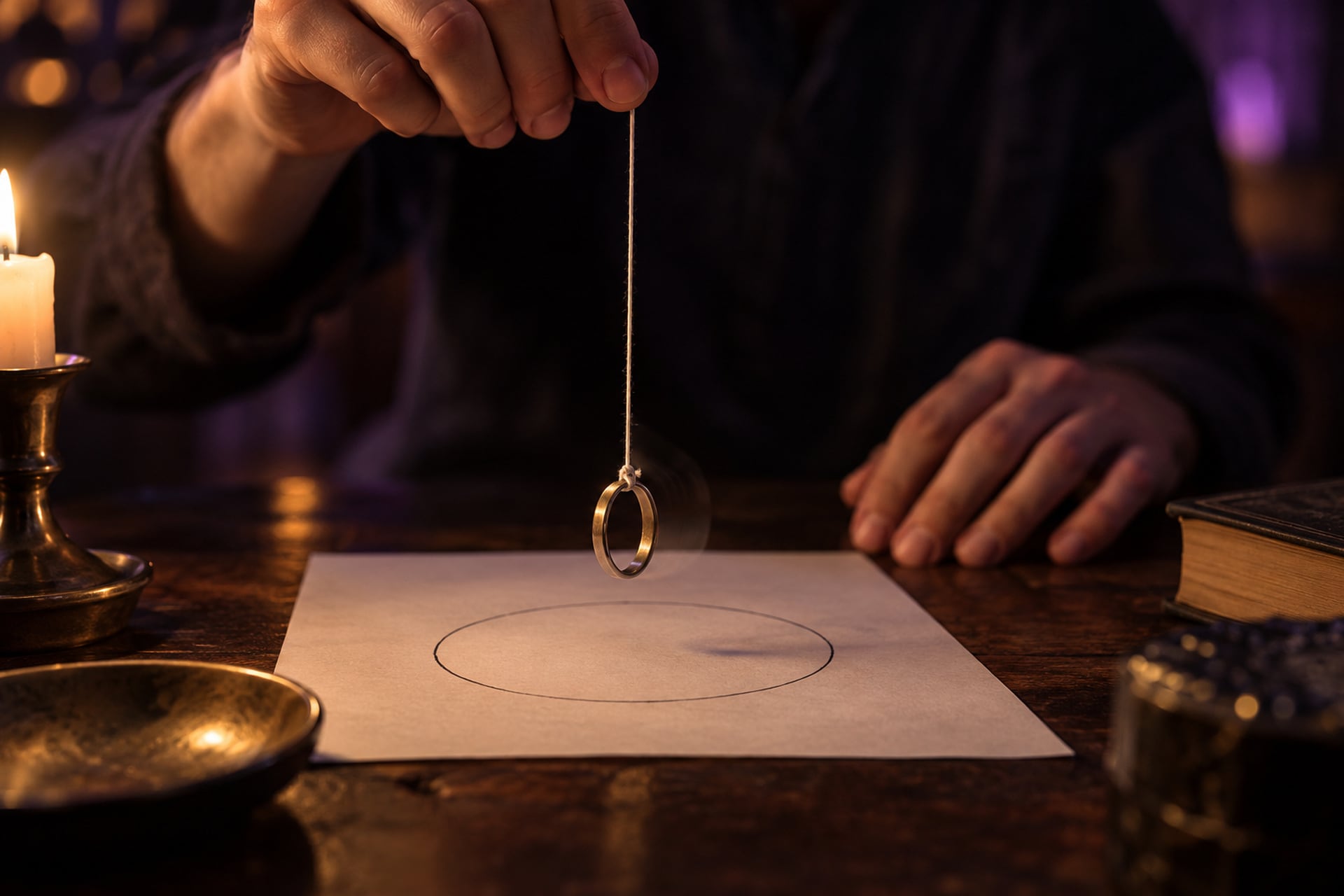
The ideomotor effect is the tendency of the body to make small muscular movements in response to a thought, without the person deciding to move or noticing that they did. Think hard about a pendulum swinging in a circle and, very often, it starts to swing in a circle. Rest your fingers on a Ouija planchette with a question in mind and it starts to drift toward an answer.
This page explains what the ideomotor effect is, the experiments that established it, the everyday examples (Ouija boards, pendulums, dowsing), and how mentalists turned it into one of the oldest mind reading performances: muscle reading, also called Hellstromism. It is part of our guide to mentalism techniques.
What Is the Ideomotor Effect?
The word combines ideo, meaning idea, and motor, meaning muscular action. The physiologist William Benjamin Carpenter introduced it in 1852 to describe movements caused by ideas rather than by conscious will. His point was simple: the thought of a movement is enough to start the movement, even when we believe we are holding still.
How It Feels from the Inside
The movements are small, usually a few millimeters, and they happen without the sense of effort that accompanies a deliberate action. That missing feeling of effort is the key. When something moves and we did not feel ourselves move it, we naturally assume something else did.
Is the Ideomotor Effect Real?
Yes. It is one of the oldest established findings in experimental psychology, and modern research on motor control and the sense of agency continues to support it. A 2019 study using motion capture found that the familiar swing of a handheld pendulum is produced when the fingers holding it generate a tiny oscillation close to the pendulum's natural frequency. The open questions today are about the details, not about whether the effect exists.
A Short History of the Ideomotor Effect
The effect was studied seriously in the middle of the nineteenth century, when spiritualism made moving tables and talking boards a popular parlor entertainment.
Chevreul and the Pendulum
The French chemist Michel Eugene Chevreul investigated the "exploring pendulum" and the divining rod, and published his conclusions in 1854. He found that a pendulum held over an object swung in the pattern he expected, and stopped behaving that way when he could not see it. His conclusion was that his own expectations were moving his hand.
Faraday and Table-Turning
In 1853, Michael Faraday investigated table-turning, in which a group of sitters rests their hands on a table until it begins to move. He placed layers of card between the sitters' hands and the table, arranged so that he could later see which had moved first. The layers showed that the hands had pushed the table, not the other way round. When he added a visible indicator that showed sitters their own pushing, the table stopped moving. Faraday published his results in the Athenaeum in July 1853.
From Psychology to Performance
Within a few decades, performers had realized that the same small movements could be read by another person. That discovery became muscle reading, covered below.
Examples of the Ideomotor Effect
Most people have experienced the ideomotor effect without knowing its name. These are the best known examples.
Ouija Boards
Several people rest their fingertips on a planchette, ask a question, and the planchette glides from letter to letter. Nobody feels that they pushed it. Each participant's small, unconscious movements toward the answer they expect add up to visible motion.
Pendulums
Hold a weight on a thread above your palm and ask it to swing for "yes". Within seconds it usually obliges. The same mechanism underlies pendulum "divination" and the old party trick of predicting a baby's sex from a ring on a string.
Dowsing Rods
Dowsers walk with two rods or a forked stick that cross or dip over the place they expect to find water or metal. The tiny hand movements that turn the rods are ideomotor. In controlled tests, where the dowser cannot know where the target is, dowsing has generally not performed better than chance.
Automatic Writing and Muscle Testing
Automatic writing, in which a pen appears to write messages by itself, and the "muscle testing" of applied kinesiology are also attributed to ideomotor action by psychologists.
Facilitated Communication
The most serious example is facilitated communication, in which a helper supports the hand of a non-speaking person as they type. Controlled tests have repeatedly shown that the messages were being produced by the facilitator, unknowingly. It is a sobering reminder that the effect is not only a curiosity: sincere, well-meaning people can be convinced that their own movements are someone else's words.
How Do Ouija Boards Work Scientifically?
The talking board became a commercial product in 1891, when US patent 446,054 was issued to Elijah Bond and Charles Kennard, and the Kennard Novelty Company began production. It was sold as a toy or game, and its popularity has risen and fallen ever since with interest in spiritualism.
Many Hands, One Answer
With several people on the planchette, each person's movements are small and unconscious, and each assumes the others are not pushing either. The result feels like an outside force. When participants are blindfolded and the board is secretly turned, the planchette tends to keep spelling toward where the letters used to be, a demonstration often used in skeptics' and psychology classes.
The UBC Study
In 2012, researchers Helene Gauchou, Ronald Rensink and Sid Fels at the University of British Columbia published a study using the Ouija board to explore unconscious knowledge. Participants answered yes or no factual questions, sometimes out loud and sometimes on a Ouija board while blindfolded, believing a partner was also on the planchette (the partner had quietly let go). On questions they felt they were only guessing at, participants were right about 65 percent of the time with the board, compared with about 50 percent when answering verbally. The researchers suggested the board was surfacing knowledge people did not know they had, not messages from anywhere else.
Why Do Ouija Boards Say Goodbye?
Commercial boards have the word GOODBYE printed on them, and the custom is to end every session by moving the planchette there. Participants expect the session to end that way, so the planchette drifts there when the questions run out. It is the ideomotor effect following a ritual.
Try It Yourself: Chevreul's Pendulum
-
Make a pendulum
Tie a ring, a key or a small nut to about 25 cm (10 in) of thread. Sit at a table and rest your elbow on it.
-
Hold still and imagine
Hold the thread between finger and thumb, with the weight hanging just above the table. Keep your hand still and imagine the weight swinging toward you and away.
-
Watch it move
Within a few seconds the weight usually starts swinging along the line you imagined. Now imagine a circle; it often changes direction.
-
Remove the expectation
Close your eyes and ask someone else to tell you what to imagine only after they have watched for a while. The swings usually become weaker and less obedient, because you can no longer see and correct the movement.
Muscle Reading: The Ideomotor Effect as Mind Reading
Muscle reading, also called contact mind reading or Hellstromism, is a performance in which the mentalist finds a hidden object, follows a path or identifies a chosen person by sensing a volunteer's unconscious movements. The volunteer concentrates on the target; their body, without their knowledge, leads the performer toward it.
The Early Muscle Readers
The American performer J. Randall Brown toured with the act in the 1870s, and the neurologist George M. Beard coined the term "muscle reading" to describe his performances. Washington Irving Bishop made the act famous, including blindfolded feats such as driving a carriage through town to find a hidden object. In Britain, Stuart Cumberland's success led to the name Cumberlandism, and in the twentieth century the performer Axel Hellstrom gave the technique the name most mentalists use today: Hellstromism.
How Muscle Reading Works in Principle
In the classic contact version, the volunteer holds the performer's wrist or hand and thinks of the target, and the performer walks with them. When the performer moves in the right direction, the volunteer follows easily. When the performer moves the wrong way, the volunteer's hand resists very slightly, or lags behind. By testing directions and feeling for that resistance, the performer narrows down the route, then the area, then the object. It is ordinary, involuntary body language, read through touch.
Muscle Reading Without Contact
Advanced performers work without touching anyone, by watching the volunteer and the audience. People tend to lean, look or tense up as the performer approaches the target. This overlaps with general people-reading skills, which we cover in our guide to reading people and body language.

Muscle reading is also one of the classic methods behind two-person "telepathy" demonstrations and finding games; see our guide on how to read minds as a performer for more ways to create that experience.
What Are the Three Phases of Muscle Reading?
If you searched for the three phases of Muscle Reading, you may be looking for something different: a study technique. "Muscle Reading" is the name of a textbook reading method taught in Dave Ellis's Becoming a Master Student, unrelated to mentalism. It splits reading into three phases:
- Before you read: preview the material, outline it and write questions you want answered.
- While you read: read with focus, mark key passages and answer your questions.
- After you read: recite what you learned, review it within a day and review it again later.
The mentalism technique has no fixed phases, though teachers often break it into finding the direction, following the path and locating the exact spot, as in the routine above.
Where to Go Next
Muscle reading pairs naturally with the verbal skills of the reader. To build a complete toolkit, from psychology to a first routine, see our guide to learning mentalism.
Free newsletter
Mentalism, made modern. In your inbox.
Occasional emails from the MentalismPro team: a technique to practice, a routine idea, and the new guides and books worth your time. No spam, unsubscribe any time.