

How to Read Minds: The Mentalist's Way
Nobody can hear another person's thoughts. Here is how performers create that experience, with tricks you can learn today.
 By The MentalismPro TeamUpdated

If you want to learn how to read minds, the honest answer comes first: nobody can hear another person's thoughts. What mentalists do is create the experience of mind reading, using psychology, observation, clever methods and a lot of practice. The result can be just as astonishing, and it has the advantage of being a skill anyone can learn.
This guide covers the three ways performers make it look as if they can read your mind, a few mind reading tricks you can perform today, how two-person telepathy acts work in principle, and what science says about reading minds for real. For the bigger picture of how the art works, see how mentalism works.
Can You Really Learn to Read Minds?
Not in the sense of hearing thoughts. The ability to read minds directly is usually called telepathy, and despite more than a century of research by parapsychologists, it has not been demonstrated in a way that convinces mainstream science. Experiments that appeared to show telepathy have generally not held up under tighter controls or independent replication.
What You Can Learn
What you can train is something more modest and more useful: noticing how people feel, predicting how they are likely to respond, and understanding what they mean when they say something indirectly. Psychologists study this under names like empathic accuracy and theory of mind, and it improves with attention and feedback. A mentalist adds methods to that foundation and frames the result as entertainment.
What Science Calls Mind Reading
There is a branch of neuroscience that does decode thoughts, in a limited sense. In 2023, a team led by Jerry Tang and Alexander Huth at the University of Texas at Austin published a study in Nature Neuroscience describing a decoder that turned fMRI brain scans into text capturing the gist of stories the participants were hearing or imagining. It required many hours of brain scans of each volunteer inside an MRI machine and their active cooperation. It is a remarkable research tool, not something that can be done to a person across a room.
The Three Tools Mentalists Use to Read Minds
Every mind reading performance is built from some combination of three tools. Understanding them is the first step to learning the craft.
1. Reading People
Reactions give away a great deal: a pause before answering, a glance, a slight smile when the performer gets close. Mentalists use the skills described in our guide to cold reading, where general statements and close attention to feedback turn into an apparently detailed reading, and in muscle reading, where a volunteer's involuntary movements lead the performer to a hidden object.
2. Psychological Influence
Some choices are more predictable than they feel. Asked to name a number, a color or a shape quickly, many people give the same few answers. Performers also guide choices with wording, timing and the order in which options are offered. These techniques are never certain, so good performers always have an alternative ending ready.
3. Method
Most of the strongest effects rely on a method that gives the performer the information directly: a mathematical principle, a forced choice, a secretly seen piece of paper or a prepared prop. The audience never suspects it because the presentation focuses on psychology. Our mentalism techniques guide covers these methods in more depth.
Simple Mind Reading Tricks for Beginners
The best way to start is with tricks that work every time, so you can focus on presentation. The routines below use no special props.
Tricks with Numbers
Mathematical principles are the most reliable starting point: the spectator does the calculation in their head, and the result is fixed no matter which number they began with. For more routines built on arithmetic, see our page of number tricks and math mind reading.
A Trick with a Clock
The routine below uses a counting principle from old parlor magic: the performer never learns the spectator's number, yet always ends on it, because the method lies in the spectator's own silent counting.
Routine
Routine: The Clock Trick
- Level
- Beginner
- Setup
- 5 minutes
- Running time
- 3 minutes
The effect
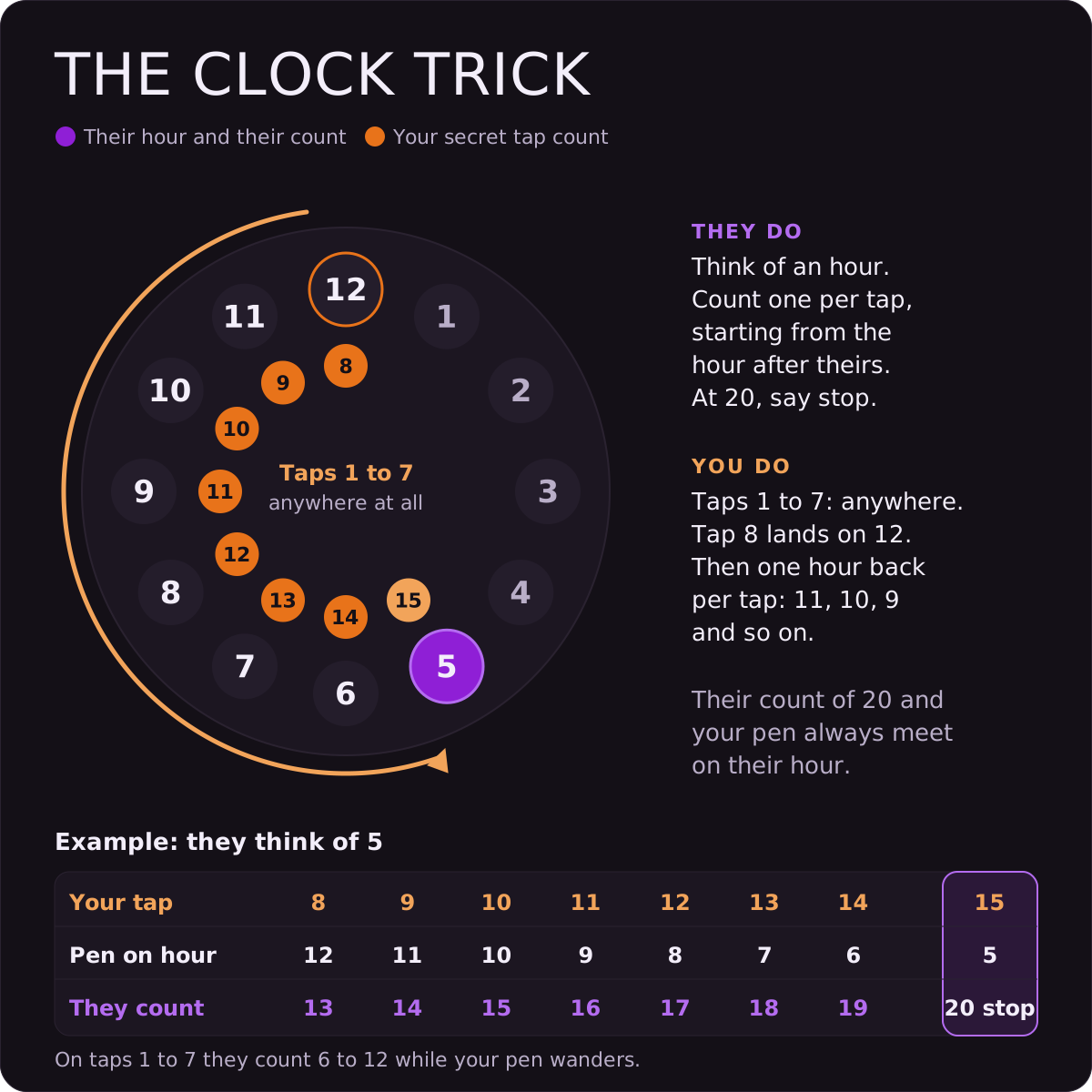
A spectator silently thinks of any hour on a clock, from 1 to 12. You tap around the clock face with a pen while they count silently. When they say stop, your pen is resting on the exact hour they chose.
You need
- A clock face, drawn on paper or a real wall clock
- A pen or pencil to point with
-
Set it up
Show the clock face and ask the spectator to think of any hour, without telling you. Turn away or look away while they choose, so the choice feels completely free.
-
Give the counting rule
Tell them: "Each time I tap, count silently, starting from the number after yours. If you thought of 5, the first tap is 6, the next is 7, and so on. When you reach 20, say stop."
-
The first seven taps
Count your own taps silently. The first seven taps can go anywhere on the clock; wander around so it looks random.
-
The eighth tap and after
Your eighth tap must be on 12. From then on, tap backward one hour at a time: 11, 10, 9 and so on. When the spectator says stop, your pen will be on their hour, whichever one they chose.
-
The reveal
Leave the pen where it is and ask them, for the first time, to name their hour aloud. Then simply lift your hand to show where the pen stopped.
Presentation notes
The trick is a classic of mathematical magic and works every time if you count your taps correctly. The arithmetic is simple: a spectator who starts counting from one more than their hour reaches 20 on exactly the tap that lands on their number. Present it as an experiment in intuition, not as a supernatural power, and never repeat it for the same audience.
Psychological Forces
A psychological force asks a question quickly, in a way that makes one answer much more likely. Classic examples include asking for a vegetable, a piece of furniture or a simple shape, and noticing how often the same few answers come back. Forces like these are part of the folklore of mentalism and are taught in many beginner books. They are not reliable on their own, so performers combine them with a method or an out.
Card Tricks
A deck of cards is the most familiar prop in mind reading, and some of the cleanest effects use it. For card routines and a broader list of effects, from easy to advanced, see our main page of mentalism tricks, which also leads to our mind reading card tricks.
Two-Person Mind Reading Tricks
Two-person acts, in which one performer appears to transmit thoughts to another, are among the oldest and most impressive forms of mentalism. They are also the easiest way to start performing with a friend.
The Great Telepathy Acts
Julius and Agnes Zancig toured in the late nineteenth and early twentieth centuries as "Two Minds With But a Single Thought". Agnes, sometimes blindfolded, identified objects that Julius was handed in the audience. Their act relied on an elaborate verbal code, and in 1924 its secrets were published in a London newspaper. In 1949, the Australian couple Sydney and Lesley Piddington performed telepathy on BBC radio, with Lesley transmitting from locations such as a diving bell and an aircraft. The Piddingtons never revealed their method and never claimed paranormal powers, leaving their listeners to judge for themselves.
How Two-Person Codes Work in Principle
A code turns information into something that can be passed openly: the wording of a question, the order of words, a pause, a gesture. The simplest codes carry a single piece of information, such as which of several objects was chosen. Professional codes can carry far more, and take months of rehearsal. The art is in making the communication invisible, so that the questions sound natural.
Routine
Two-Person Routine: Black Magic
- Level
- Beginner
- Setup
- 10 minutes with your partner
- Running time
- 5 minutes
The effect
Your partner leaves the room. The group chooses any object in sight. Your partner returns, and you point to objects one by one, asking "Is it this?" Your partner says no each time, until you point to the chosen object, which they identify immediately.
You need
- Any room with a variety of objects
-
Agree the signal
This is a classic parlor game. The secret: the chosen object is always the one you point to immediately after a black object. Agree on this with your partner in advance.
-
Send your partner out
Ask the group to choose any object while your partner is out of earshot. Make a show of letting them change their minds.
-
Point to objects
Point to several objects, one at a time, with the same question each time. Your partner answers no. When you are ready, point to something black, then to the chosen object.
-
Repeat with variation
Do it two or three times. Vary how many objects you point to before the signal, so nobody spots a pattern in the count.
-
Upgrade the code
If someone guesses the color, switch to a different agreement, such as the object after one with four legs, or after something you touch with your left hand. The audience's theory collapses and the mystery grows.
Presentation notes
Simple codes like this are where many performers start, and they teach the most important lesson of two-person work: the method is easy, the acting is everything. Your partner should pause, concentrate and occasionally hesitate before answering.
How to Practice Mind Reading as a Performer
The method of most mind reading tricks takes minutes to learn. What separates a puzzle from a miracle is presentation.
Script Your Words
Write down exactly what you will say, from the first line to the reveal. Small changes in wording change how fair the trick feels. Rehearse the script until it sounds unscripted.
Slow Down the Reveal
Beginners rush the moment they know the answer. Take your time: ask the spectator to concentrate, reveal the answer in stages ("It's something small... something metal..."), and let them confirm each step. A slow reveal feels like reading a mind; a fast one feels like a trick.
Perform for Real People Early
Practice in front of a mirror only goes so far. Perform for friends who will be honest, then for people who do not know you, and pay attention to their reactions. Every performance teaches you something about timing.
Be Honest About What You Do
Mentalists frame their skill differently: some describe it as psychology, some as intuition, some leave it open. What you should never do is claim real psychic powers, or use mind reading to give advice about health, money or relationships.
When you are ready to build a structured plan, from the first routine to a short set, our guide to learning mentalism walks through the order.
Free newsletter
Mentalism, made modern. In your inbox.
Occasional emails from the MentalismPro team: a technique to practice, a routine idea, and the new guides and books worth your time. No spam, unsubscribe any time.