

Learn mentalism
How Does Mentalism Work? Inside the Mind Reading Illusion
Mentalists do not read minds. They do something more interesting: they combine method, psychology and performance so well that it feels like they do.
 By The MentalismPro TeamUpdated

How does mentalism work? Short version: a mentalist never actually reads your mind. The performer gets the information, or controls the outcome, through a method you did not notice, and then presents the result as if it came straight out of your head. Everything else, from the long pause before the reveal to the near miss that makes the hit feel real, is there to hide that method and make the moment unforgettable.
This guide explains how mentalists work in practice: the five layers that sit under almost every routine, the principles behind mind reading, how mentalists guess names, why the experience feels so convincing, and what that means if you want to learn it yourself. If the art itself is new to you, start with what a mentalist is. We teach general principles and classic, published ideas. We do not expose the methods of commercial effects or of living performers.
How Does Mentalism Work? The Five Layers
Pull apart almost any mentalism routine and you find the same five layers. Not every routine uses all five, but the strongest ones do, and the way they combine is what separates an amateur's trick from a professional's moment.
1. The Method
The method is the part that guarantees the result. It might be a force, which makes a free choice not quite free; a way of secretly learning information the performer should not have; a mathematical principle that always ends on the same number; or a piece of preparation done before the show. The method is usually simple. That surprises people, but simplicity is a feature: simple methods are reliable, and reliability lets the performer focus on the audience.
2. Psychology
People are more predictable than they think, especially under mild time pressure. Asked to think of a number, a color or a shape quickly, a large share of people land on the same few answers. Mentalists use these tendencies, and the language of psychology, to narrow choices and to make the effect look like insight. On its own, psychology is a gamble; layered over a real method, it adds texture and makes the reveal feel earned.
3. Observation and Reading People
A spectator's clothes, posture, accent and reactions all carry information. Mentalists listen to the answers people give, watch how they give them, and adjust. This is where cold reading lives: the art of building a convincing reading from general statements, educated guesses and the subject's own feedback.
4. Memory and Preparation
A large part of the work is invisible because it happens before the show or inside the performer's head. Memory systems let a mentalist recall long lists, page contents or a stacked deck. Pre-show work means some of the information was gathered before the spectator thinks the effect began. The audience only sees the moment, never the hours behind it.
5. Presentation
Presentation turns a method into an experience. Scripting controls exactly what the spectator remembers. Misdirection moves attention away from the method at the key moment. Storytelling gives the effect a reason to exist. Many performers argue presentation is the biggest of the five layers, because a weak method well presented fools people, and a strong method badly presented rarely does.
How Do Mentalists Read Minds?
When a mentalist names the word you were thinking of, one of a small number of things happened. Mind reading effects work by one or more of these general principles, all of them documented in the classic literature of the art.
Forcing the Choice
A force gives the spectator the feeling of a free choice while the outcome is already decided. Card magicians have dozens of forces, and Theodore Annemann published a whole booklet of them in 1933, 202 Methods of Forcing. Mentalists also use verbal and psychological forces, where the wording of the question steers the answer. If the performer knows the choice in advance, "reading" it afterwards is a matter of acting.
Getting the Information Secretly
Many effects ask the spectator to write something down: a name, a word, a drawing. The classic literature describes many ways to learn what was written without seeming to look, from billet work (the handling of small folded papers) to well-timed glimpses. The audience forgets that anything was written at all and remembers only that they "thought" of it.
Reading Reactions
Some effects genuinely rely on reading the person. In muscle reading, a performer holding a spectator's wrist follows tiny unconscious movements toward a hidden object, a principle linked to the ideomotor effect that William Carpenter named in 1852. In readings, the performer offers statements and adjusts to the spectator's responses. These methods are real skills, but they are fallible, so performers frame them in ways that make small misses part of the show.
Codes Between Two People
Two-person telepathy acts, from Robert-Houdin's "second sight" in 1840s Paris to the double acts of vaudeville, rely on systems that let one performer pass information to another in plain sight. The systems are elaborate and take months of joint rehearsal, which is why the best of these acts were often married couples or family members.
Mathematics and Self-Working Principles
Some effects work by arithmetic or by the structure of a deck or a list, so that every route leads to the same answer. Number effects of this kind are a favorite for beginners because they need no skill to execute, only careful scripting so that nobody notices the math.
Routine
Try It: The Odd Number Experiment
- Level
- Beginner
- Setup
- None
- Running time
- 1 minute
The effect
You ask a friend to think of a two-digit number with specific rules. Before they answer, you have already written a number on a folded piece of paper. Often, it matches. When it does not, the presentation still works, because you framed it as a psychology experiment from the start.
You need
- A pen
- A small piece of paper
-
Write your prediction
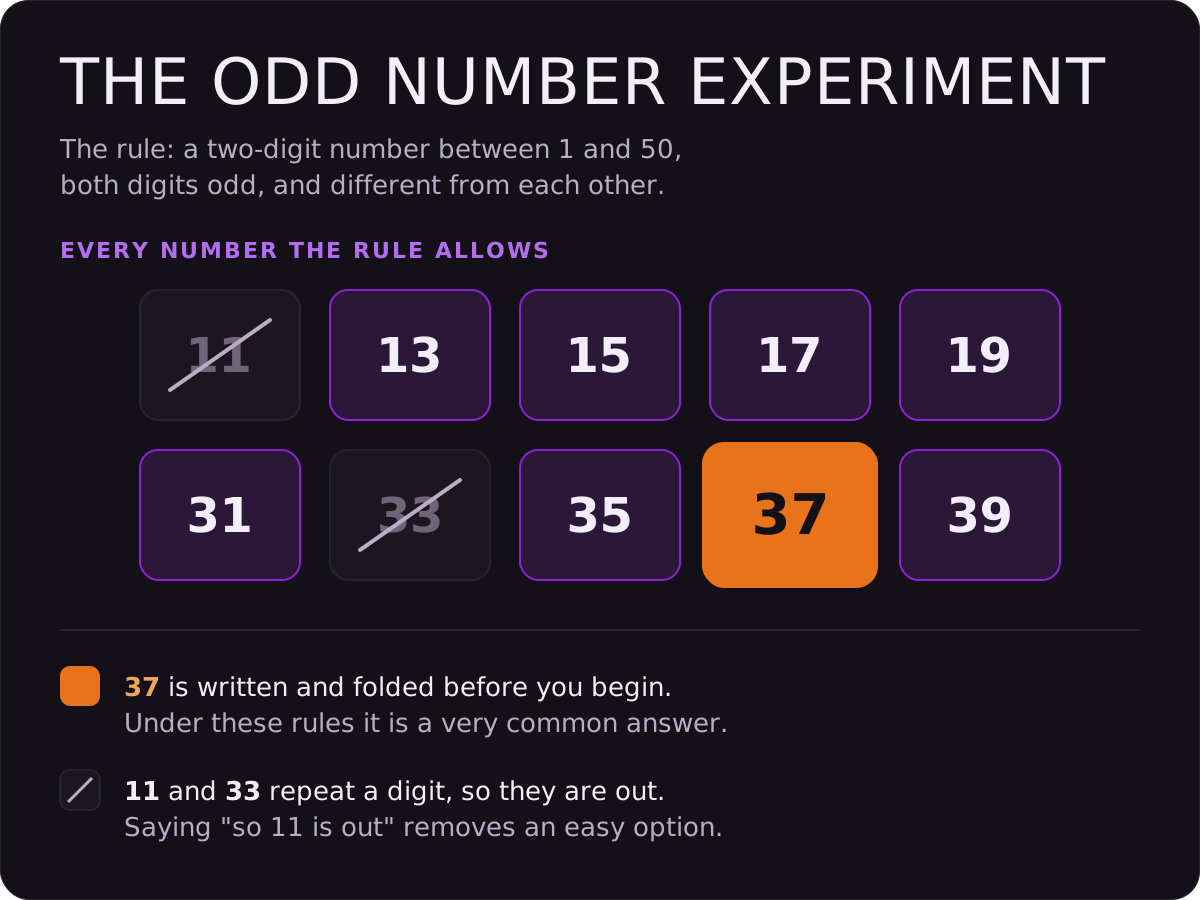
Before you begin, write 37 on the paper, fold it and put it on the table. This is a well-known psychological tendency that has circulated among magicians for decades: under these rules, 37 is a very common answer.
-
Give the rules
Say: "Think of a two-digit number between 1 and 50. Both digits must be odd, and they must be different. So 11 is out, because the digits are the same. Got one? Don't change it." The example 11 removes an easy option, and the speed of the instructions pushes people toward an answer that feels random.
-
Frame it as psychology
Before the reveal, say you are running a small experiment on how people make random choices. This framing matters: it makes a hit feel like insight and a miss feel like data.
-
The reveal
Ask for the number, then let them unfold the paper. If it matches, let the moment breathe. If they said 35 or 39 or another number, show the paper and explain that 37 is what most people pick, and ask why they think they went elsewhere. Either way the conversation is interesting.
Presentation notes
This is a demonstration of psychology, not a guaranteed effect, and that is the lesson: professionals rarely rely on a psychological tendency alone. They layer it over a method that covers the misses, which is exactly what the five layers above describe.
How Do Mentalists Guess Names?
Naming a stranger's first love or childhood best friend is one of the strongest effects in mentalism, and one of the questions people ask most. Several general approaches exist, and performers usually combine them.
The Name Was Written Down
The most common approach is that the name was written, somewhere, at some point, and the performer found a way to learn it. The writing is often made to feel incidental, so the spectator later remembers only thinking the name.
Narrowing It Down Live
A performer can also arrive at a name gradually: "I'm getting a short name... it feels old-fashioned... there's a strong sound at the start." Each statement invites a reaction, and reactions carry information. Done well, this looks like a struggle to tune in, which is more dramatic than an instant hit.
Information Gathered Before the Show
Some performers work with information gathered before the moment of the effect, a practice known in the trade as pre-show. In a corporate or televised setting, the line between preparation and performance is invisible to the audience.
Why Mentalism Feels So Real
The method explains how the performer gets the answer. It does not explain why smart, skeptical people walk away convinced they saw something impossible. That part comes from how memory and belief work.
Memory Edits the Performance
Spectators do not remember a routine accurately. They remember a cleaner version, in which the choice was totally free and the performer never touched anything. Researchers Richard Wiseman and Emma Greening showed in a 2005 study that verbal suggestion from a performer changed what witnesses reported about a fake psychic's metal bending demonstration. Mentalists script with this in mind: they tell the audience what just happened, and that summary becomes the memory.
Vague Statements Feel Personal
In 1948 psychologist Bertram Forer gave his students a personality sketch built from an astrology book and told each of them it was a personal assessment; most rated it as an excellent description of themselves. The tendency became known as the Barnum effect, and it is one reason readings feel so specific even when the words are general.
Hits Are Remembered, Misses Are Forgotten
People remember the moment the performer was right and forget the questions and guesses that came before. A reading that contains twenty statements and five clear hits is remembered as five hits.
The Performer Admits Nothing Mid-Show
Magic invites the question "how did they do it?" Mentalism, presented as psychology or intuition, offers an answer before the question is asked. If the performer says they read your body language, many people accept that and stop looking for a method.
How Does Oz Pearlman Do It?
Much of the current interest in how mentalism works comes from Oz Pearlman's television and street segments, in which he names passwords, PIN codes and old flames of celebrities and interviewers. We do not speculate about the methods of a living performer. What can be said is what he says himself: in interviews he has stated that he cannot read minds and describes his work as reading people, built on the tools of magic such as misdirection, influence and suggestion. Our page on how Oz Pearlman does it covers the general principles and his own published comments, without exposing his act.
Can You Learn How Mentalism Works?
Yes, and knowing how mentalism works does not spoil it. Performers still fool each other with methods they understand, because the presentation is what lands. If you want to perform, the path runs through the same five layers: a few reliable methods, the psychology that dresses them, enough observation to adjust in the moment, memory work, and endless rehearsal of the presentation.
Where Beginners Should Start
Start with self-working effects, where the method takes care of itself and you can focus on the script. Then add forces, then basic reading techniques, then the classic texts. Our learn mentalism plan sets out the order and how long each stage tends to take.
What Not to Do With It
Use these skills to entertain. Do not present yourself as psychic to people who may believe it, and do not give readings that could shape someone's decisions about health, money or relationships.
Free newsletter
Mentalism, made modern. In your inbox.
Occasional emails from the MentalismPro team: a technique to practice, a routine idea, and the new guides and books worth your time. No spam, unsubscribe any time.