Max Major: Who He Is, and Is His Hypnosis Real?
 By The MentalismPro TeamUpdated
As an Amazon Associate we earn from qualifying purchases. How we choose products.
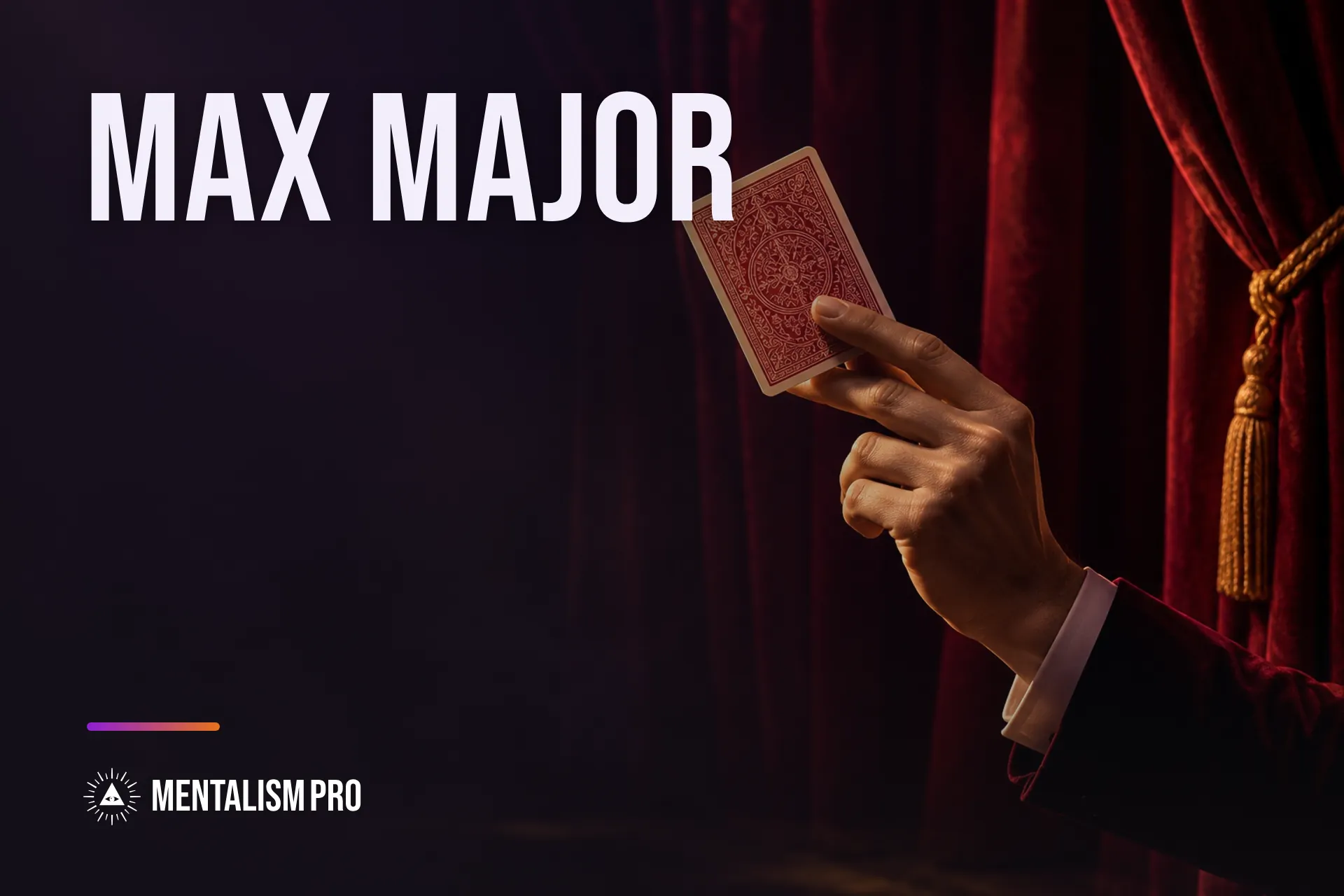
Max Major is an American mentalist who built an audience with live shows, corporate events and short viral videos, and who reached a much larger one after a 2020 appearance on America's Got Talent. Search interest in his name has climbed again since a stunt on a streamer's livestream in November 2024, and the same questions come up every time: who is he, what exactly does he do, and is his hypnosis real?
This page answers those questions using what he and his booking agencies say publicly, what the press reported, and what psychology research says about stage hypnosis and mind reading. It does not explain how any of his effects are done. Those are his professional property, and the general principles behind this kind of performance are covered on our pages about how mentalism works and whether mentalism is real.
Who Is Max Major?
Max Major describes himself as a mentalist. His official site, maxmajor.net, presents him as a "World-Renowned Mentalist" offering entertainment and keynotes for corporate events and select private parties.
Background
The most direct account of his early life comes from a September 2016 PhillyVoice interview by Brandon Baker. In it he said he got into mentalism to outsmart his older brother, that he began researching it at 11 and gave his first performance at 14. He said he had spent about 20 years studying body language, psychology, hypnosis, suggestion and magic. The same interview records his story that at 18 he watched his father get hypnotized and, as he put it, his dad was cured of a smoking habit. That is his own account and it is not independently verified.
His agency profile at Eagles Talent says he lives in Las Vegas, Nevada. We found no primary source for a birth date or a legal name, so this page does not give either. Treat any website that does with caution, especially the ones that bundle age, height and net worth in one headline.
How He Became Known Online
Two things turned a working live performer into a recognizable name. The first was America's Got Talent. His agency bio says he was invited to compete on season 15 in 2020 and became the first contestant in the show's history to go from an online audition to the finals, and quotes Simon Cowell calling his mind reading "one of the most astonishing things I've seen in my entire life." Those are the agency's claims, repeated on his own site, which links a clip of the appearance.
The second was short video. The same bio says his viral mind-reading videos passed one billion views in 2022, and his site lists TikTok, YouTube, Instagram, X and Facebook accounts under the handle @itsmaxmajor. Both figures are self-reported.
Live Shows and Corporate Work
His site lists "over 3,500 live performances", while other agency pages give lower totals, so the exact count is promotional and should not be quoted as fact. The consistent part is the market: corporate events, private parties and what the agencies call interactive keynotes. His site shows a logo carousel with companies such as Goldman Sachs, Facebook, Microsoft, Costco and Salesforce, and the Eagles Talent bio also says he has been called before two Department of Defense intelligence agencies, which it presents as his own claim. We have no way to confirm which individual events happened, so read the client list as the speaker's marketing.
What Max Major Does on Stage
Public descriptions of his shows are consistent. The material mixes what the audience sees as mind reading, hypnosis-style segments, and demonstrations of influence. He has described all of it as built on observation and practice, not on any ability that other people lack.
Mind Reading
The core of the act is the familiar mentalism premise: he appears to know what a volunteer is thinking or has chosen. In the PhillyVoice interview he named guessing a person's phone passcode as his favorite trick, and said everything he does is "based on a face", meaning observation. That is a statement about attitude, not a method, and professional mentalists often describe their work this way while using many other tools. Our page on how to read minds separates the entertainment version from the real skills.
Hypnosis-Style Segments
Several of his clips and shows feature hypnosis or hypnotic suggestion, which is why "Is Max Major hypnosis real?" is such a common search. In the interview he listed hypnosis among the disciplines he studied. Whether a given segment is hypnosis in the clinical sense, suggestion, compliance or something else is a question this page cannot settle from outside. The section below explains why even researchers disagree about that line.
Influence Demonstrations
His keynote pitch is that audiences can learn how to take his powers "from the stage to the office", according to the Eagles Talent bio. In practice this means talks about body language, attention and persuasion framed with live demonstrations. Persuasion research of this type, such as reciprocity and commitment, is real and well studied. We summarize the evidence that has held up, and the claims that did not, on our mind tricks page.
Is Max Major's Hypnosis Real?
The honest answer has two parts. Hypnosis exists as a research topic. But what an entertainer does on stage with it is show business, and the label "real" or "fake" fits badly.
What He Says Himself
He does not claim supernatural power. In the 2016 PhillyVoice interview he rejected the comparison with people who claim to be psychic and called mentalism a marriage of disciplines: body language, psychology, hypnosis, suggestion and magic. Asked how the tricks work, his answer there was a lot of hard work and practice plus showmanship. A performer who says this is describing a craft, which is the correct frame for watching him.
What Research Says About Stage Hypnosis
Academic discussion of stage hypnosis, summarized in Wikipedia's article on the subject, notes that the causes of volunteers' behavior are disputed. Some researchers favor altered consciousness. Others point to compliance, social pressure from an expectant audience, the wish to be the center of attention, and ordinary suggestion. The same article, citing Barber and Weitzenhoffer, says stage hypnosis tends to rely on participant compliance, participant selection and, at times, deception of the audience. It also says volunteering at all tends to select outgoing, cooperative people. Those are general descriptions of the genre, not statements about any particular performer.
The practical consequence is that a stage hypnosis clip tells you very little about hypnosis as a clinical tool. A volunteer who behaves oddly on stage is responding to a room, an expectation and a persuasive host. Our guide to how to hypnotize someone covers what hypnosis can and cannot do, and why the movie version does not exist.
Real, Fake or Neither?
Three claims are worth keeping separate. First, that the people on stage are experiencing something genuine to them: very plausible, since expectation and social pressure are powerful. Second, that a special hypnotic state forces them to obey: not supported as a general claim. Third, that a performer has reliable power over strangers: not supported by evidence anyone has published. Max Major has not, to our knowledge, made that third claim.
How Does Max Major Do It?
We do not explain how his effects are achieved. Professional mentalists earn a living from methods that took years to build, and guessing at them in public would be unfair and, most of the time, wrong.
What can be said safely is the general structure of the art. Performance mentalism combines observation of body language and speech, psychology of attention and suggestion, careful choice of volunteers, showmanship and, in many acts, techniques borrowed from conjuring. The audience sees only the result. That is why people with identical impressions of the same act disagree about whether it is "real".
If you want the principles without the secrets of anyone alive, start with our page on how mentalism works. For the claim that you could do it by reading faces, our pages on how to read people and cold reading show what that skill really delivers, which is a probability, not certainty.
Max Major's Viral Moments
Beyond his America's Got Talent run, one episode dominates searches.
The Kai Cenat Stunt
On a Tuesday night in November 2024, during streamer Kai Cenat's Mafiathon 2 subathon, Max Major performed a stunt outside Cenat's house. According to Complex's report of November 27, 2024, several nooses were visible, Major asked Cenat to pick one, Major appeared with a noose around his neck, and Cenat pulled a handle after a countdown. Major briefly appeared hanged. Cenat told his crew not to show the imagery.
The two sides described it differently. Cenat said he and his team were blindsided and expected a different stunt. Major said in a YouTube video that it was "all according to my plan" and that he knew Cenat would pick the red handle, per the same report. Because the stunt ended with the imagery of a staged hanging, it drew widespread backlash, which is why it became a news story rather than a clip.
We take no view on what was planned. We note that mentalism routines often present an apparent failure as part of the act, and that this alone does not settle whether someone was surprised by it.
Other Clips
His 2020 America's Got Talent clip remains the one most linked from his own site. Beyond that, his short videos with strangers and creators are what his agency bio means by viral mind reading. We do not describe individual clips here, because most are quick effects where describing the surface would mean describing the method.
Max Major vs Other Mentalists
Mentalists differ most in packaging. Max Major sits in the modern online-first group: short, shareable effects, corporate bookings and a speaker's pitch. That puts him closer to a creator-performer than to a theater act.
Oz Pearlman is the nearest comparison, another well-known working mentalist. Our page on how Oz Pearlman does it sets out the same rule we follow here: what he has said publicly, plus general principles, and no methods. Derren Brown works in a different register, with theatrical shows, a skeptic's commentary and a long record of explaining the psychology behind his work, which is why his book is a better starting point if you want to understand the craft.
For the wider field, with performers from the nineteenth century to today, see our guide to famous mentalists.
Where to See Him
His site's navigation, as of October 2026, lists live events, keynotes, virtual programs and a booking form with separate categories for event inquiries and press requests. He appears to work mainly through private corporate and event bookings, and the agency bios describe those as his core offering. The pages we read did not list public ticketed dates, so confirm any dates at maxmajor.net or with the booking agency before you plan around one. Past public dates, like the 2016 Franklin Institute run mentioned in the PhillyVoice interview, do not tell you where he is performing now.
If You Like This: Where to Start Reading
-
Best overview
Derren BrownBeginner
No book by Max Major turned up in the sources we read. If his style is what drew you in, this is a good explanation of suggestion, memory and the psychology behind mentalism, written by a performer who is open about it.

Free newsletter
Mentalism, made modern. In your inbox.
Occasional emails from the MentalismPro team: a technique to practice, a routine idea, and the new guides and books worth your time. No spam, unsubscribe any time.