

Tricks & routines
Easy Card Tricks: 8 Self-Working Tricks Anyone Can Learn
 By The MentalismPro TeamUpdated
As an Amazon Associate we earn from qualifying purchases. How we choose products.
The best easy card tricks are self-working: the method lives in the order of the cards, a count or a little arithmetic, so they work every time without sleight of hand. You can learn any of the eight tricks below in an evening with an ordinary deck, and in most of them the spectator does the dealing or cutting, which is what makes them look impossible.
They run from the easiest to the strongest, each with the effect, the setup, the full method and presentation notes. All are classics found in beginner collections such as Karl Fulves's Self-Working Card Tricks (Dover, 1976), free to learn and perform.
The 8 Easy Card Tricks at a Glance
"Setup" is work done before anyone watches; "learn time" is a realistic estimate for a complete beginner.
| Trick | Level | Setup | Learn time |
|---|---|---|---|
| 1. Upside-Down Card | Beginner | One reversed card | 15 min |
| 2. Down-Under Deal | Beginner | None | 10 min |
| 3. 10 to 19 Prediction | Beginner | Know the 10th card | 15 min |
| 4. Clock Trick | Beginner | Know the 13th card | 20 min |
| 5. Spelling Bee | Beginner | 13-card stack | 30 min |
| 6. Pile Total | Intermediate | None | 30 min |
| 7. Mutus Nomen Dedit Cocis | Intermediate | None | 45 min |
| 8. Cutting the Aces | Beginner | Four aces on top | 15 min |
What Self-Working Means
The procedure guarantees the outcome: mathematics, a card's position or the way the cards are dealt. Your attention can go to the audience.
What You Need
A standard 52-card deck, jokers removed; a poker-size Bicycle deck is easiest to handle. Add pen and paper for the two predictions.
Easy Card Tricks You Can Learn Tonight
These four need no setup or a few seconds of it, and the method is impossible to get wrong once understood.
1. The Upside-Down Card
A family classic built on one secret: a single card turned face up at the bottom of the deck.
Routine
The Upside-Down Card
- Level
- Beginner
- Setup
- 10 seconds
- Running time
- 2 minutes
The effect
A spectator pushes their chosen card face down into the deck. You snap your fingers and spread the cards: their card is now the only one face up.
You need
- One deck
-
Secret setup
Turn the bottom card of the deck face up. From above, the deck looks normal.
-
The selection
Spread the cards and let the spectator take one. Stop well before the bottom so the reversed card stays hidden.
-
The turnover
While they show their card around, lower your hands and turn the deck over. The reversed card now sits on top, back up, so the deck still looks face down.
-
The return
Keep the deck squared while they push their card face down into the middle.
-
Fix and reveal
Behind your back, turn the deck over and flip the bottom card to match the rest. Snap your fingers and spread: one face-up card, theirs.
Presentation notes
Keep everyone in front of you, and turn the deck while they are busy with their card, never while they watch your hands.
2. The Down-Under Deal
The spectator shuffles, chooses and deals. A counting principle that works with packets of 4, 8, 16 or 32 cards does the rest.
Routine
The Down-Under Deal
- Level
- Beginner
- Setup
- None
- Running time
- 3 minutes
The effect
The spectator shuffles a packet, peeks at one card and deals the packet away. The last card left in their hand is the one they peeked at.
You need
- One deck
-
Count the packet
Casually count 16 cards off the deck and hand them over.
-
Shuffle and peek
They shuffle, hold the packet face down and remember the bottom card.
-
The deal
Top card down on the table, next card under the packet, next down, next under, until one card remains.
-
The reveal
They name their card and turn over the one in their hand. It matches.
Presentation notes
When the first card goes down, the bottom card of a 16-card packet always survives. Frame the deal as "eliminating cards at random".
3. The 10 to 19 Prediction
A force: a procedure that looks free but always lands on a card you know. Add a written prediction and it becomes a small miracle.
Routine
The 10 to 19 Prediction
- Level
- Beginner
- Setup
- 1 minute
- Running time
- 3 minutes
The effect
The spectator picks any number from 10 to 19, deals, adds two digits and deals again. The card they arrive at matches your prediction.
You need
- One deck
- Pen and paper
-
The prediction
Note the 10th card from the top, write it down and fold the paper.
-
First deal
They choose a number, say 15, and deal 15 cards one at a time into a pile.
-
Second deal
They add the digits (1 plus 5 is 6), pick up the pile and deal off 6 cards.
-
The reveal
The last card of the second deal is the original tenth card. Turn it over, then open the prediction.
Presentation notes
It works for every number from 10 to 19, not for 20. Perform it first, before anyone shuffles.
4. The Clock Trick
The self-working Clock card trick turns a hidden count into a prediction on a clock face. It differs from the tapping Clock Trick in our guide to mentalism tricks for beginners, and the two pair well.
Routine
The Clock Trick
- Level
- Beginner
- Setup
- 1 minute
- Running time
- 4 minutes
The effect
The spectator pockets a secret number of cards. You deal twelve cards as a clock face, and the card at their secret hour is the one you predicted.
You need
- One deck
- Pen and paper
-
The prediction
Note the 13th card from the top and write it down.
-
The secret number
Turn away while they take 1 to 12 cards off the top and pocket them uncounted.
-
Count the hours
Say "a clock has twelve hours", deal 12 cards one at a time into a pile and drop the pile back on top of the deck.
-
Build the clock
Deal the top 12 cards face down in a circle, from one o'clock round to twelve.
-
The reveal
They count their pocketed cards. If it is 7, turn over the card at seven o'clock, then open the prediction.
Presentation notes
Never ask for the number before the clock is laid out. The twelve-card deal is the method, so give it a reason and take your time.
Self-Working Card Tricks That Look Hard
These four take a 13-card setup, some arithmetic or a short memory aid. In return the spectator handles most of the cards, which is why these easy card tricks look hard to the people watching.
5. The Spelling Bee
An old spelling trick from countless beginner books: spell each value, one card per letter, and that value appears on the last letter.
Routine
The Spelling Bee
- Level
- Beginner
- Setup
- 5 minutes
- Running time
- 3 minutes
The effect
You spell A-C-E, one card per letter, and the ace turns up on the E. Then the two, the three and so on, up to K-I-N-G.
You need
- 13 cards, one of each value
-
Set the stack
From the top, face down: queen, 4, ace, 8, king, 2, 7, 5, 10, jack, 3, 6, 9. Suits do not matter.
-
Spell the ace
Say "A" and move the top card to the bottom; "C", another to the bottom; on "E", turn the top card up: the ace.
-
Continue
Spell T-W-O, T-H-R-E-E and onward the same way, turning up the card on each last letter.
-
The finish
On K-I-N-G, the king is the last card left.
Presentation notes
Keep the set packet in your pocket until needed, and let children spell along with you.
6. The Pile Total
A mathematical classic with a fully shuffled deck: you never see the important cards, yet you announce their total.
Routine
The Pile Total
- Level
- Intermediate
- Setup
- None
- Running time
- 5 minutes
The effect
With your back turned, the spectator builds three piles, each hiding a card. You hold the leftover cards for a moment and announce the total of the three hidden cards.
You need
- A full deck of 52 cards
-
Values
Ace is 1, number cards face value, jack 11, queen 12, king 13.
-
Build a pile
They turn up the top card, say a 9, deal cards onto it counting 10, 11, 12, 13, then turn the pile over so the 9 is hidden.
-
Three piles
They make three piles this way and hand you the leftovers.
-
The count
Quietly count the leftovers and subtract 10. With a 9, a 5 and a king, 37 cards are left; 37 minus 10 is 27.
-
The reveal
Announce the total, then let them turn over and add the three cards.
Presentation notes
Check the deck is complete. Count while you talk about "feeling the weight" of the cards.
7. Mutus Nomen Dedit Cocis
Named after a meaningless Latin phrase used as a memory aid: each of its ten letters appears exactly twice.
| Row | Word | Letters |
|---|---|---|
| 1 | MUTUS | M U T U S |
| 2 | NOMEN | N O M E N |
| 3 | DEDIT | D E D I T |
| 4 | COCIS | C O C I S |
Routine
Mutus Nomen Dedit Cocis
- Level
- Intermediate
- Setup
- Memorize four words
- Running time
- 5 minutes
The effect
Up to ten spectators each remember a pair of cards. The cards are dealt into four rows, each spectator says only which rows hold their cards, and you point to their pair every time.
You need
- 20 cards
-
Pairs
Deal 20 cards face up in ten pairs; each spectator remembers one pair.
-
Gather
Pick up the pairs one at a time, keeping each pair together.
-
Deal the grid
Deal into four rows of five, following the words: first two cards to the two M places, then U, T, S, N, O, E, D, I and C.
-
Find the pair
Rows 1 and 2 means the two M cards; only row 3 means the two D cards. Every answer points to one letter.
Presentation notes
More participants make it stronger.
8. Cutting the Aces
The strongest finish here: the spectator cuts, mixes and finds all four aces. You never touch the cards.
Routine
Cutting the Aces
- Level
- Beginner
- Setup
- 30 seconds
- Running time
- 4 minutes
The effect
The spectator cuts the deck into four piles and mixes them by simple rules. The top card of every pile is an ace.
You need
- One deck, four aces on top
-
Four piles
They cut off about three quarters and place it to the right, cut two thirds of that further right, then half of that further right. The aces top the rightmost pile.
-
Mix a pile
Starting from the left, they move three cards from the top to the bottom, then deal one card onto each other pile.
-
Repeat
Same with the second and third piles, and last the aces pile.
-
The reveal
They turn over the top card of each pile: four aces.
Presentation notes
The aces pile must be handled last. Guide their hands so the top portion always travels right.
Make a Card Trick Feel Like Mind Reading
A small script change turns "is this your card?" into naming a card you seem to read from the spectator's face.
Name, Don't Find
In the 10 to 19 Prediction and the Clock Trick you already know the card. Skip the written prediction and name it in stages: color, suit, value.
Turn the Pile Total Into a Thought
Have the spectator add the three cards silently, then reveal the number digit by digit. The same idea drives our mind reading card tricks, with full methods for the key card, the 21-card trick and the Si Stebbins stack.
The Psychology Behind It
People remember the reveal, not the procedure. Our guide on how to read minds as a performer covers the observation techniques mentalists add to card principles, always as entertainment.
Magic Card Tricks for Beginners: How to Practice
Looking effortless takes a week of short sessions. This plan suits any of the card tricks for beginners above.
A Four-Session Practice Plan
-
The method alone
Run the trick ten times in silence until you never check the steps.
-
Write the script
Write each line in your own words and give every count a reason.
-
Rehearse aloud
Perform for an empty chair and record it on your phone to spot hesitations.
-
One friendly audience
Show one kind person and note their questions.
Five Beginner Mistakes
| Mistake | Result | Fix |
|---|---|---|
| Repeating a trick | The method shows | Once per audience |
| Explaining the method | The wonder disappears | Smile and move on |
| Silent dealing | It feels like a puzzle | Talk while you count |
| Rushing the reveal | The climax falls flat | Pause, then reveal |
| Shuffling a set deck | The trick fails | Do set-up tricks first |
Choosing a Deck
A fresh poker-size deck handles better than a worn one. For children, a boxed beginner set adds variety. As a first trick deck, the Invisible Deck is the classic buy; its secret comes with it, so we leave it there.
What to Buy for Easy Card Tricks
Every trick on this page works with the first item.
-
1Practice decks
Bicycle Playing Cards, 2 Pack (Red and Blue)
Two standard poker-size decks: one for practice, one for performing.
-
2For kids
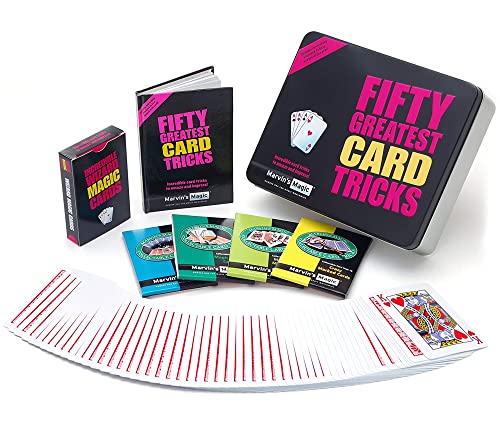
Marvin's Magic Fifty Greatest Card Tricks
A boxed set of 50 card tricks for ages 8 and up.
-
3First trick deck
Invisible Deck (Bicycle cards)
The classic any-card-named effect, made with Bicycle cards, instructions included.


Books for Learning More Card Tricks
Stay Self-Working
Fulves's Self-Working Card Tricks is the natural next book; Mark Wilson's collection adds variety.
Add Sleight of Hand
The Royal Road to Card Magic by Jean Hugard and Frederick Braue (1948) is the standard first course, Roberto Giobbi's Card College goes deeper, and S. W. Erdnase's The Expert at the Card Table (1902) is the advanced classic. For mind reading rather than card magic, see the best mentalism books.
Card Books Worth Owning
-
Best next step
Karl FulvesBeginner
A low-cost Dover classic of tricks that work by principle, not skill.
-
Best for variety
Mark Wilson's Greatest Close-Up Magic Tricks
Mark WilsonBeginner
More than forty close-up tricks explained step by step.
-
First sleight-of-hand course
Jean Hugard and Frederick BraueBeginner to intermediate
The classic course, from basic shuffles to complete routines.
-
Most thorough course
Roberto GiobbiBeginner to intermediate
A complete, carefully structured course in sleight-of-hand card magic.
-
The advanced classic
S. W. ErdnaseAdvanced
The classic treatise on card manipulation, for after the basics.


Free newsletter
Mentalism, made modern. In your inbox.
Occasional emails from the MentalismPro team: a technique to practice, a routine idea, and the new guides and books worth your time. No spam, unsubscribe any time.