

Tools & tricks
Zener Card Test: Take the ESP Test Online and See What Chance Predicts
 By The MentalismPro TeamUpdated
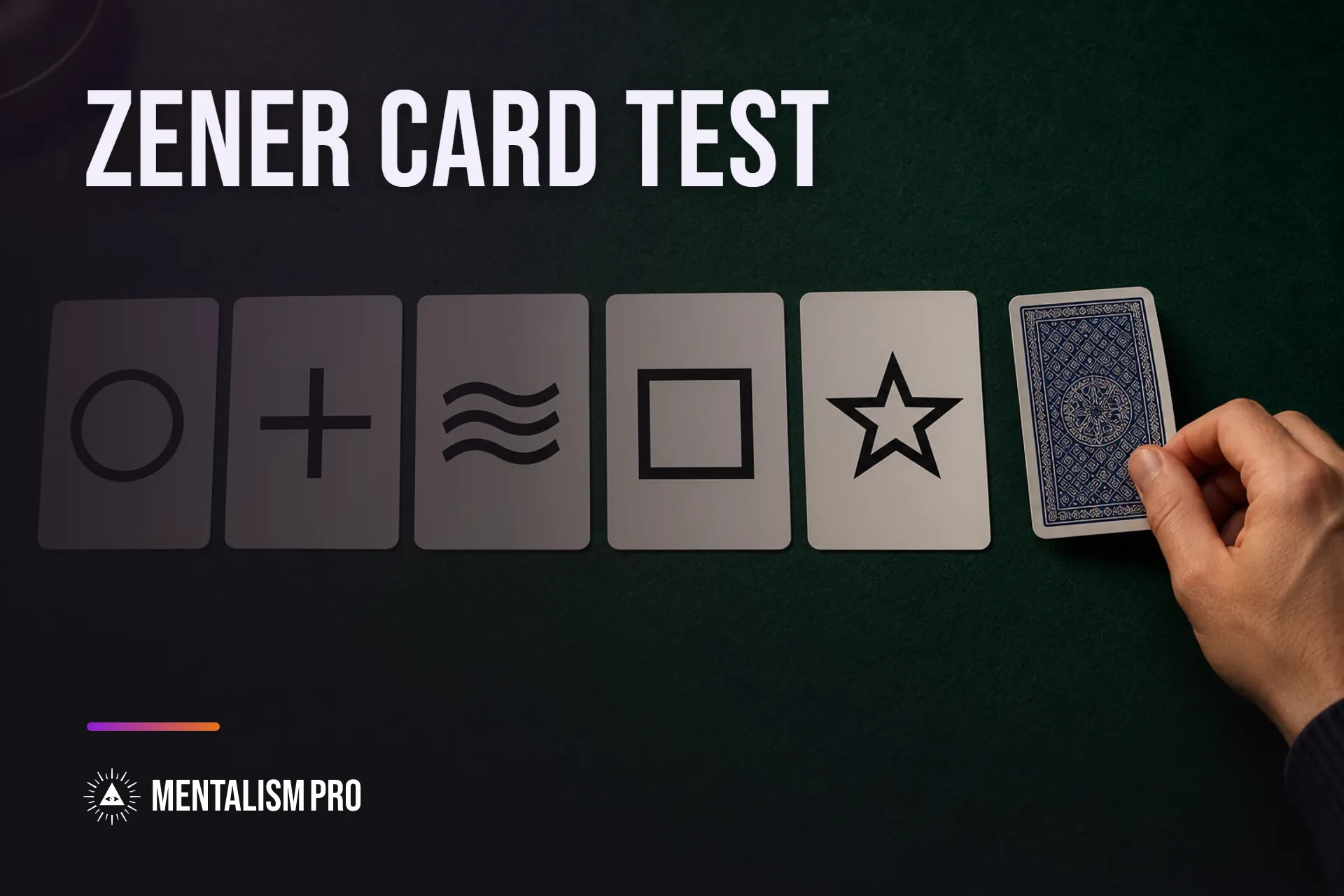
A Zener card test asks you to guess, one card at a time, which of five symbols is on a shuffled deck of 25 cards. Guessing alone gets about 5 right. This page lets you take the test in your browser, then shows your score next to the exact odds of reaching it by luck, so you can see for yourself what chance predicts.
Nothing is saved or sent anywhere: the shuffle happens on your device and the result disappears when you close the tab.
Take the 25-card test
A shuffled deck of 25 cards, five of each symbol. For each card, pick the symbol you think is on it. You get your score at the end, with nothing sent or saved anywhere.
Seeing the cards lets you count what is left, which pushes the average above 5. Leave this off for a fair test.
Your score: out of 25
- Average by chance
- 5 out of 25
- Standard deviation
- 2 cards
- Chance of this score or higher
See every card and guess
Run the Same Test With a Real Deck
-
Print and cut the deck
Use the Print the deck button above to get a sheet of 25 cards, five of each symbol, then cut along the lines. Any standard Zener deck works the same way.
-
Shuffle well
Shuffle many times, or have a second person shuffle. Poor shuffling leaves patterns that make a run easier to predict.
-
Guess without feedback
The guesser names a symbol for each card and a helper writes the guesses down in order. The helper must not react, and the guesser must not be told which guesses were right until all 25 are done.
-
Score and compare
Count the matches only at the end, then find the score in the table further down this page.
What Your Score Means
Each card has five possible symbols, so a blind guess is right one time in five. Over 25 cards that gives an average of 5 correct, with a standard deviation of 2. Individual scores of 3 to 7 are the ordinary spread, and most runs land there.
How the Odds Are Calculated
The table below uses the binomial distribution with 25 trials and a one in five chance on each, a standard model for guessing without feedback. It is calculated by the same formula the test above uses to score your run, so the two always agree.
| Score out of 25 | Chance of this score or higher | Roughly |
|---|---|---|
| 0 | 100% | nearly every run |
| 1 | 99.6% | nearly every run |
| 2 | 97.3% | 1 run in 1 |
| 3 | 90.2% | 1 run in 1 |
| 4 | 76.6% | 1 run in 1 |
| 5 (average) | 57.9% | 1 run in 2 |
| 6 | 38.3% | 1 run in 3 |
| 7 | 22.0% | 1 run in 5 |
| 8 | 10.9% | 1 run in 9 |
| 9 | 4.68% | 1 run in 21 |
| 10 | 1.73% | 1 run in 58 |
| 11 | 0.555% | 1 run in 180 |
| 12 | 0.154% | 1 run in 649 |
| 13 | 0.037% | 1 run in 2,710 |
| 14 | under 0.01% | 1 run in 13,107 |
| 15 | under 0.01% | 1 run in 73,720 |
| 16 | under 0.01% | 1 run in 484,516 |
| 17 | under 0.01% | 1 run in 3,746,783 |
| 18 | under 0.01% | 1 run in 34,417,797 |
| 19 | under 0.01% | 1 run in 380,521,299 |
| 20 | under 0.01% | 1 run in 5,156,501,803 |
| 21 | under 0.01% | 1 run in 87,899,464,969 |
| 22 | under 0.01% | 1 run in 1,959,377,149,900 |
| 23 | under 0.01% | 1 run in 60,808,656,167,507 |
| 24 | under 0.01% | 1 run in 2,950,724,988,880,720 |
| 25 | under 0.01% | 1 run in 298,023,223,876,952,700 |
Why Someone Always Scores High
If twenty friends each take one run, one of them will probably score 9 or more by luck alone. That is not a psychic result. It is what happens when many people each get a chance at an unlikely number, and it is the main lesson the test teaches.
One Run Is Not Evidence
An unusual score on a single run is a reason to run the test again, not a conclusion. A claim worth taking seriously needs a result that repeats across many runs, with every run counted, under controls tight enough that nothing could leak. For where the science stands on that question, read is mentalism real.
How the Zener Test Was Used
The five-symbol deck was designed in the early 1930s at Duke University by the perceptual psychologist Karl Zener together with the parapsychologist J. B. Rhine. Rhine used it in long series of card-guessing experiments and described them in his 1934 book Extra-Sensory Perception, which made the cards famous.
Why These Five Symbols
The shapes are simple, clearly different from each other, and easy to draw by hand. Five symbols and 25 cards make a run short enough to finish in a few minutes while keeping the odds easy to calculate: one in five per card.
What Happened Next
Early reports of above-chance scores faded when critics pointed to weak shuffling, readable card backs and recording choices, and the results did not hold once the controls were tightened. The full story, with the main criticisms and the cards used in a classic film scene, is on our ESP cards guide.
Why Feedback Breaks the Test
The test above leaves feedback off by default for a reason. If a guesser is told after each card what it was, the guesser can count. A deck holds exactly five of each symbol, so once three stars have been shown, only two stars remain among the unseen cards, and the best guess shifts to a symbol that has appeared less often.
Card Counting With Five Symbols
Keeping track of the cards already shown and always naming a symbol that has appeared the fewest times lifts the average above 5 without any extrasensory perception. The mathematics of guessing with feedback was studied by the statisticians Persi Diaconis and Ronald Graham in a 1981 paper on sequential experiments with feedback to subjects.
What Researchers Took From It
Diaconis also wrote about the statistical problems of ESP research in the journal Science in 1978. The practical lesson for anyone running a test is the one built into this page: record every guess first, reveal nothing until the end, and judge the score against the chance table, not against a feeling.
If you switch on Show each card after I guess, you are free to try counting. Your average should rise above 5, and the result line will note that the run was not a fair test.
Use the Test in a Class or at a Party
The test works best as a group activity, because the group is where chance shows its shape. Everyone takes one run, scores are collected on a board, and the class compares the spread with the table above.
A Simple Group Setup
Ask each person to take one run with feedback off and call out their score. Write the scores in a column and sort them. Most will sit between 3 and 7, a few will be lower, and with a big enough group one or two will land at 8 or 9 without any special ability.
Questions Worth Asking
Ask the high scorers to run the test again. Their second scores usually fall back toward 5, which is the pattern chance predicts and a neat way to introduce the idea that extreme results tend to be followed by ordinary ones. Then ask the group what evidence would convince them: how many runs, under what controls, and with whom counting the scores.
Turn It Into a Routine
A Zener deck is also a stage prop. Audiences already know what the cards are, so a performer needs almost no explanation, and the five symbols make a simple code for a partner act. Two routines using the deck, with full steps, are on the ESP cards page, and more mind reading card work is in our card tricks guide.
The difference between the two uses is the whole point. The test above asks whether anyone can beat chance. A mentalism routine is entertainment and says so. To see how performers create the feeling of reading a mind, start with how mentalism works.
Where to go next: the ESP cards guide for the history, decks and tricks, the Barnum effect for why vague results feel personal, and mentalism tricks for routines you can learn.
Free newsletter
Mentalism, made modern. In your inbox.
Occasional emails from the MentalismPro team: a technique to practice, a routine idea, and the new guides and books worth your time. No spam, unsubscribe any time.