Psychology
Reading the Mind in the Eyes Test: What It Measures and How to Read Your Score
 By The MentalismPro TeamUpdated
As an Amazon Associate we earn from qualifying purchases. How we choose products.
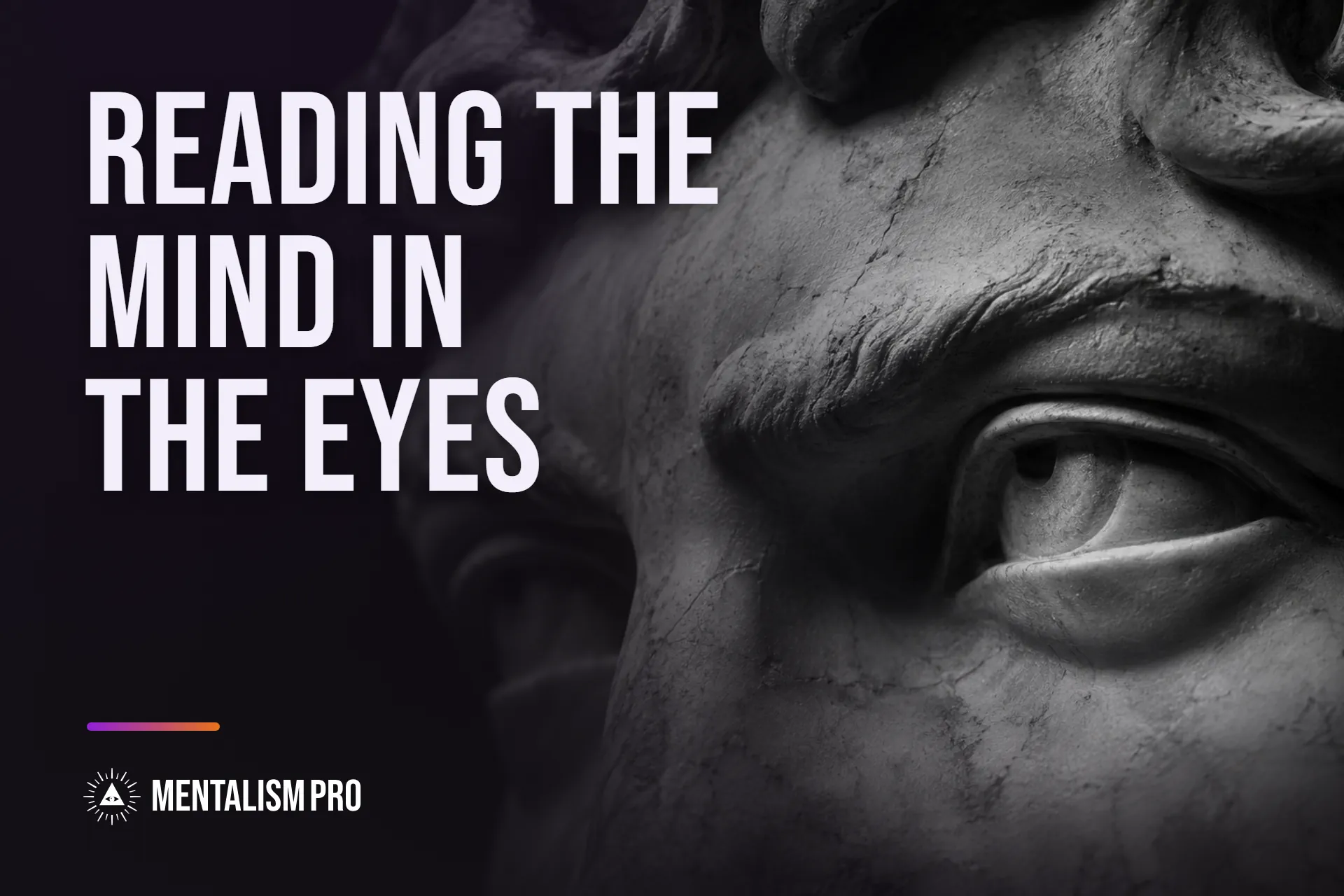
The Reading the Mind in the Eyes Test, usually shortened to RMET or the Eyes Test, shows you a series of photographs cropped to a person's eyes and asks which of four words best describes what that person is thinking or feeling. It is one of the best known tests in psychology of how well people read others, and one of the most debated.
This page explains what the test is, where to take the official free version, how scores are described in the research, and what critics say it measures. We do not host the test itself: the Autism Research Centre at the University of Cambridge publishes it for non-commercial research use and does not allow it to be adapted without permission, so the page sends you to the source instead.
What the Eyes Test Is
The test was created by Simon Baron-Cohen and colleagues at Cambridge, and the version most people take is the revised one described in a 2001 paper by Baron-Cohen, Sally Wheelwright, Jacqueline Hill, Yogini Raste and Ian Plumb in the Journal of Child Psychology and Psychiatry. Its aim was to measure how well adults can infer mental states from a small part of the face, an ability often called theory of mind.
How the Items Work
The revised version has 36 items. Each one shows a pair of eyes and four words such as a feeling or an attitude, and the respondent picks the one that fits best. Each item is marked right or wrong against a fixed key, and the total is the score out of 36.
Why It Became Popular
The test is short, free to download and easy to score, so it spread across psychology, psychiatry and neuroscience. It also gave a pleasing way to talk about a skill that is hard to measure. That popularity is part of why its limits matter, which later sections cover.
How to Take It
The Autism Research Centre lists the adult Eyes Test on its own site, with instructions and the test pages. You can find it at the Autism Research Centre's Eyes Test (Adult) page. Use that version rather than a copy from a quiz site, because copies often change the photographs, the word lists or the key.
A Sensible Way to Take It
Read the instructions first and take the test in one sitting, in a quiet place, without a time limit. Pick the word that fits best, even if two seem close, and do not look anything up while you answer. When you finish, score it only against the official key.
What Not to Do
Do not memorize the answers and retake the test, because a second score then measures memory. Do not take it repeatedly hoping to improve a number, and do not treat a copy found online as a source of truth for your score.
How It Is Scored
One point goes to each item where your chosen word matches the key, so the score runs from 0 to 36. The research then compares totals across groups, not across single people.
Typical Scores in the Research
In the 2001 study, normal adult groups scored roughly 26.2 to 30.9 out of 36, which is 74% to 86% correct, and adults with Asperger syndrome or high-functioning autism averaged 21.9, about 61%, as reported in a 2015 analysis by Sally Olderbak and colleagues in Frontiers in Psychology. In that same analysis, an online adult sample averaged 27.2 out of 36 with a standard deviation of 3.8.
What Above and Below Those Figures Mean
A score near the middle of those group averages is ordinary. A score a few points below or above says little by itself, because group averages cannot tell you what one person's number means. The 2001 study compared groups, which is different from diagnosing an individual, and the test is not a diagnostic tool on its own. If you have questions about your own results, a qualified clinician is the right person to ask.
What the Test Does and Doesn't Measure
The Eyes Test has been used for more than twenty years, and a number of studies have asked what it actually measures. The answers are more mixed than its reputation.
The Vocabulary Problem
Olderbak and colleagues found in 2015 that the full 36-item test is not homogeneous and has poor internal consistency, and that it correlates strongly with vocabulary, at 0.54 in their first study. That link means word knowledge plays a part in getting items right. They proposed a 10-item short form with better consistency and said future versions should depend less on vocabulary.
Recent Doubts About the Structure
In 2025, Wendy Higgins, Victoria Savalei, Vincent Polito and Robert Ross published an analysis in Assessment of nine large non-clinical datasets, with from 558 to 9,267 participants. A single-factor model did not fit well in any of them, some items failed the original validation criterion in several datasets, and apart from a handful of easy items, participants sometimes disagreed substantially about which answer was correct. They concluded the test may not be a valid measure of social cognitive ability. They note that their samples did not include clinical or autistic participants, so their findings apply to the general population.
What It Can Still Do
None of this makes the test useless. It remains a short, free way to look at how people choose between mental-state words for photographed eyes, and it is a useful example of how a famous test can be questioned. What the evidence does not support is reading it as a clean score for empathy or for how well you read people in real life.
Reading Eyes in Mentalism
Mentalists and magicians have long claimed that the eyes give away thoughts, and they use that belief on stage. The honest version of the claim is smaller than the stage one. People do show signals in their faces, but a single pair of cropped eyes, like those in the Eyes Test, carries far less than a person talking to you in context.
What Performers Actually Use
A performer reads the whole situation: how the spectator stands, how fast they answer, where they look when they are asked a question, and how they react to a guess. A single photograph of eyes tells almost nothing about any of that. Our guides to micro expressions and how to read people cover what face and body cues are worth and where the myths begin.
Eyes and Lying
The belief that eyes reveal a lie is one of the most common. What works and what does not is in how to tell if someone is lying, and the way readers use guesses and reactions to seem insightful is in cold reading. If the question of fast versus careful judgment interests you, the intuition test is a short companion to this page.
A Book to Read Next
-
Practical starting point
Joe NavarroBeginner
A former FBI agent's guide to reading body language in context, a better match for real conversations than a cropped photo of eyes.

Where to go next: micro expressions for what faces can and cannot show, how to read people for body language in context, and the intuition test for a look at quick judgments.
Free newsletter
Mentalism, made modern. In your inbox.
Occasional emails from the MentalismPro team: a technique to practice, a routine idea, and the new guides and books worth your time. No spam, unsubscribe any time.