

Learn
How Do Magicians Do Tricks? The Principles Behind Every Illusion
The seven kinds of magic effects, the methods that produce them and what neuroscientists have learned from magicians about attention.
 By The MentalismPro TeamUpdated
As an Amazon Associate we earn from qualifying purchases. How we choose products.
Magicians do tricks with a mix of technique, psychology and preparation. No trick on this page is explained from start to finish, on purpose: the point is to show how magic works in general, and the answer is almost always a combination of four things working at once.
This guide covers the seven kinds of effects magicians perform, the methods that produce them, what neuroscientists have found when they studied magicians and why the profession keeps its secrets. If you would like a specific trick explained, see magic tricks revealed, which covers classic public-domain tricks one by one.
The Short Answer: Misdirection, Technique, Psychology and Preparation
Almost every trick is a mix of these four ingredients. What changes from trick to trick is the balance.
Misdirection
Wikipedia describes misdirection as a form of deception in which the performer steers the audience's attention toward one thing to hide another. Dariel Fitzkee, quoted there, said that the magician's real skill lies in influencing the spectator's mind, and T. A. Waters called misdirection the cornerstone of nearly all successful magic.
Technique
Technique means the physical skill: handling a coin or a deck of cards so that the audience believes one thing while your hands do another. A magician practices a move until it looks like nothing at all.
Psychology and Preparation
Psychology is the art of anticipating what an audience will assume. Preparation is everything done before the show: setting up, building a prop, rehearsing the words. The audience sees only the surprise.
The 7 Types of Magic Effects
Magicians disagree about how many types of effect exist, and Wikipedia's list of effects is longer, adding transposition, escape and prediction. The seven below are a popular shorter list, and many routines combine several of them. The cups and balls, for example, can include vanishes, productions, penetrations, transpositions and transformations in one presentation.
1. Production
Something appears from nothing. The standard example is a rabbit from an empty hat. Wikipedia lists the production as the first of the effect types.
2. Vanish
Something disappears, such as a coin or, on a large stage, an assistant from a cabinet. The French drop, one of the oldest vanishing methods, is covered in coin tricks.
3. Transformation
Something changes state, such as a silk handkerchief changing color or one card turning into another.
4. Restoration
A destroyed object is made whole again: a cut rope, a torn newspaper, a snapped pencil.
5. Teleportation
Something moves from one place to another, such as a ring that turns up inside a ball of wool.
6. Levitation
An object or person floats. Methods mentioned by Wikipedia include the Asrah and the Balducci levitation. John Nevil Maskelyne and his partner Cooke, established at the Egyptian Hall in London in 1873, are credited by Wikipedia with inventing many illusions still performed, levitation among them.
7. Penetration
A solid object passes through another, such as linked steel rings. A coin that seems to pass through a table is a small version of the same idea.
The Methods Behind Them
An effect is what the audience sees. A method is how it is done. The same effect can have many methods, and the same method can produce many effects. That is why knowing one method never explains all magic.
Sleight of Hand
Sleight of hand is manual dexterity used to handle objects covertly. It is the signature method of close-up magic, and one reason a table trick can fool people from a foot away. Wikipedia notes that Reginald Scot's The Discoverie of Witchcraft (1584) already explained sleight-of-hand methods with coins, rope and paper.
Gimmicks and Special Props
A gimmick is an object built or altered to do something an ordinary object cannot. Hidden compartments and specially constructed props belong here. A magician's own gimmick is usually the part of the act that stays in the dressing room.
Forces
A force is a procedure that looks like a free choice but always lands on the same outcome. When a magician asks you to name any card, there are ways in which the card was never really up to you. The method is a principle of choice, not a deck trick.
Mathematical Principles
Some tricks need no skill at all: a count, a piece of arithmetic or the order of the cards guarantees the result. These are called self-working. Our easy card tricks guide has eight that work by procedure.
Stooges and Confederates
A confederate is a secret helper, planted in the audience or backstage. Wikipedia mentions Harry Houdini's use of collusion with audience members, and notes that camera magic often uses paid extras posing as spectators. Many tricks use no confederate at all, and live close-up magic seldom does.
Misdirection: What Science Says
Magicians have exploited human attention for centuries, and in the last twenty years scientists have started to study it. The results explain why you can look straight at a trick and still miss it.
The 2008 Paper
In 2008 Stephen Macknik, Susana Martinez-Conde and colleagues, including the magicians Mac King, James Randi, Apollo Robbins, Teller and John Thompson, published "Attention and awareness in stage magic: turning tricks into research" in Nature Reviews Neuroscience. The abstract says that magic shows reflect performers' deep intuition for human attention and awareness, and that neuroscientists can learn powerful methods from magicians to manipulate attention and awareness in the laboratory.
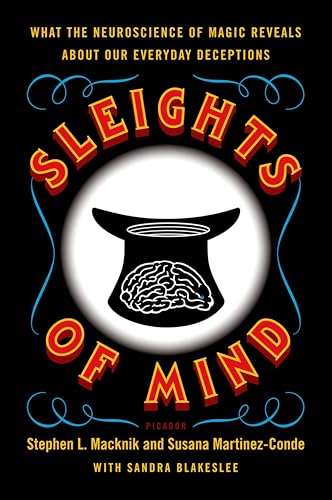
Sleights of Mind
Macknik and Martinez-Conde later wrote Sleights of Mind with the science writer Sandra Blakeslee (Henry Holt, 2010). Wikipedia says the book argues that magic works because human attention and awareness have built-in limits that magicians can exploit, and introduces the field of neuromagic.
Experiencing the Impossible
Gustav Kuhn's Experiencing the Impossible (MIT Press, 2019) is a further book on the subject for readers who want to go deeper.
Conversation Shapes Choices
Wikipedia also cites a 2020 study in PNAS by Pailhes and Kuhn on how conversational primes influenced card choices, a reminder that a magician's patter is part of the method as well as the entertainment.
How Mentalists Differ
Mentalists use many of the same methods but present them differently. A magician says "watch this impossible thing"; a mentalist says "I will try to read your mind", and the presentation, rather than the props, is what changes. The overlap is large, which is why we answer the mentalism question on its own page: how does mentalism work.
Shared Methods
Forces, mathematical principles and sleight of hand all appear in both arts. For the difference between them, read mentalism vs magic.
The Extra Skill
Mentalists add observation, conversation and what is often called cold reading: making careful, general statements and reading how a person reacts. It is a performance skill, not a supernatural one.
Why Magicians Don't Reveal Their Secrets
Magicians traditionally keep their methods from audiences. Wikipedia reports that membership in professional magic organizations often requires a commitment never to reveal the secrets of magic to non-magicians. Among the organizations it names are the Society of American Magicians, where Harry Houdini served as president, and The Magic Circle, formed in London in 1905.
The Reason
Keeping the method hidden preserves the illusion, and the performer's work is the reason people pay to watch. The mentalist Joseph Dunninger often used an older saying, which Quote Investigator traces to sources before him: "For those who believe, no explanation is necessary; for those who do not believe, no explanation will suffice."
What Is Fair Game
Not all secrets are protected. Public-domain tricks and self-working classics have appeared in books for centuries, and Wikipedia notes that Reginald Scot published methods in 1584. Our guide to magic tricks revealed sticks to those and never to the signature routines of working performers.
The Better Way to Know
Knowing how a trick works rarely ruins it for the person who learns it. Learning makes you notice how much work goes into a simple surprise. If you would like to try it yourself, easy magic tricks is the place to begin.
Books on How Magic Works
-
Best for the science
Stephen Macknik, Susana Martinez-Conde and Sandra BlakesleeBeginner
A neuroscientist's tour of how magicians exploit the limits of attention and awareness.
-
Best for learning the tricks
Mark Wilson's Complete Course in Magic
Mark WilsonBeginner
A full beginner course whose chapters teach the effects and methods described above.

Where to go next: see classic methods in magic tricks revealed, start learning with easy magic tricks, or compare the arts in mentalism vs magic.
Free newsletter
Mentalism, made modern. In your inbox.
Occasional emails from the MentalismPro team: a technique to practice, a routine idea, and the new guides and books worth your time. No spam, unsubscribe any time.