

How to Levitate: The Balducci Levitation and Other Floating Illusions
The street levitation anyone can learn, how objects are floated, how stage magicians lift a person, and whether real levitation is possible.
 By The MentalismPro TeamUpdated
As an Amazon Associate we earn from qualifying purchases. How we choose products.
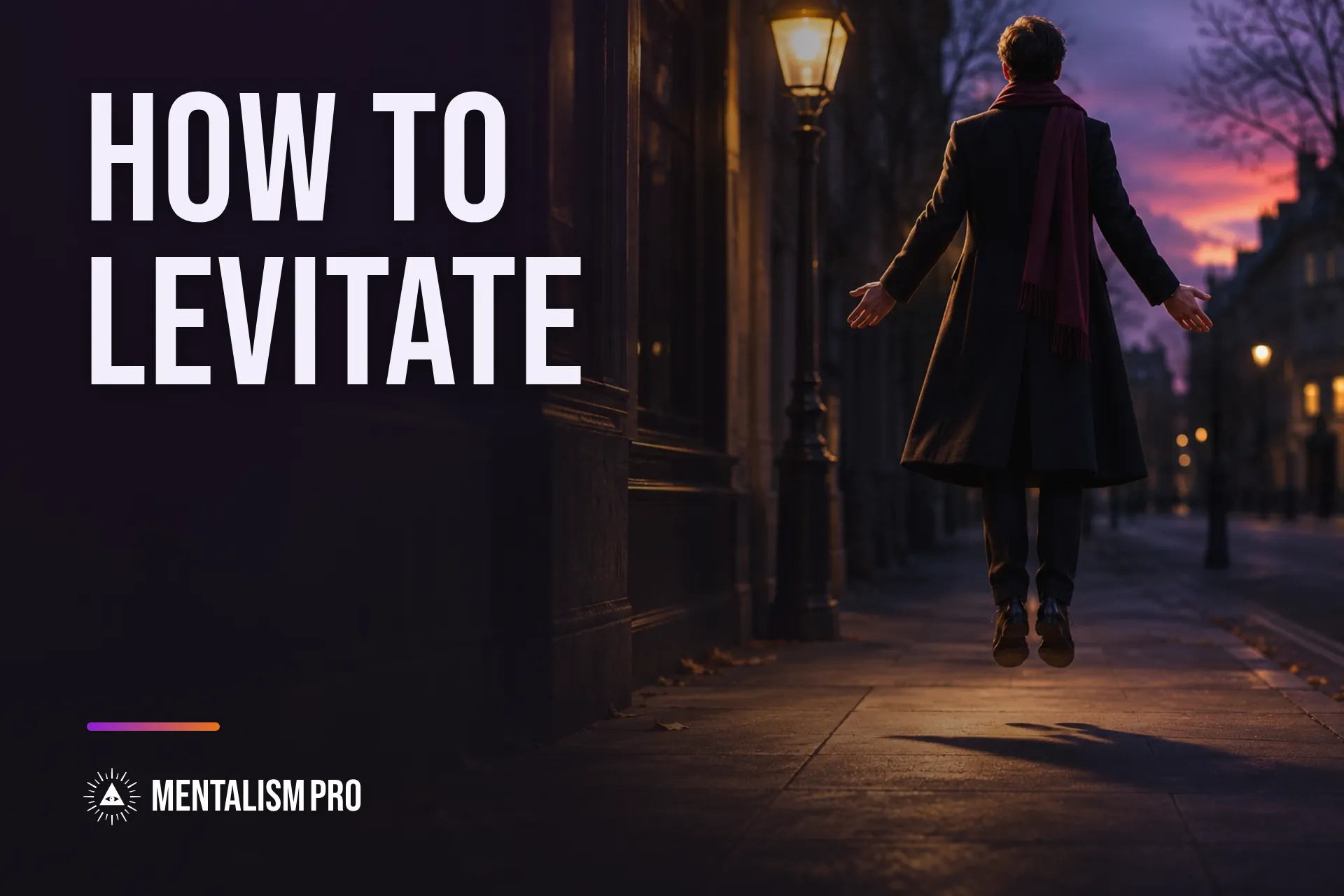
Levitation is the illusion of floating: a person or an object seems to rise from the ground with nothing holding it up. The short answer to the question behind the search is that no one has shown a human body floating unaided, but a street levitation you can learn in an afternoon, the Balducci levitation, makes a spectator swear you rose a few inches off the pavement. It is also one of the oldest ideas in stage magic.
This guide covers whether real levitation is possible, how the Balducci levitation works and how to avoid its usual mistakes, how street performers handle other floating effects, how objects are made to float, how stage magicians float a person, and why the eye accepts all of it.
Can Humans Really Levitate?
As a paranormal skill, the evidence says no. Claims of floating monks, mediums and mystics have a long history, but none has survived a test in which a magician helped design the conditions. Randi's million-dollar challenge for proof of any paranormal ability ended in 2015 with no winner, as described in our spoon bending guide. For the wider question of moving things with the mind, see is telekinesis real.
The Frog That Floated
Real levitation does exist in physics, and the best-known example is a frog. According to Wikipedia, the physicist Andre Geim used a powerful magnet to levitate a live frog, working from the magnetic properties of water, which is the main thing a frog is made of. Geim and Michael Berry reported the work in the European Journal of Physics in 1997, in a paper titled "Of flying frogs and levitrons," and they shared the 2000 Ig Nobel Prize in Physics for it. The effect is called diamagnetic levitation: water is weakly repelled by a strong magnetic field.
The lesson for magicians is a sobering one. Floating a frog took an extremely strong magnet, and nothing like that is hidden in a performer's shoes. A person on a sidewalk is not levitating by magnetism, and neither is anyone on a stage.
Why Levitation Looks So Convincing
People expect gravity to hold, so any sign that it has been suspended gets noticed and remembered. A performer who rises two inches, with a believable reaction and a little misdirection, gives the brain just enough to build a story from: the viewer fills in the rest and remembers the height as larger. Wikipedia's entry on the Balducci levitation notes that a small subtlety, such as bending the knees on landing, can make spectators believe the feet rose higher than they did, and that audiences often describe an exaggerated effect. Our guide to how magicians do tricks covers the general principles.
How to Do the Balducci Levitation
The Balducci levitation is the classic impromptu levitation. According to Wikipedia, Ed Balducci published the first known description in July 1974, in The Pallbearer's Review, under the title "Impromptu Levitation." He wrote "Originator unknown" and said his cousin, Erwin Levine, had shown it to him years earlier, so the name stuck despite his disclaimer. Magicians including David Roth, Paul Harris and David Blaine spread the effect, and Blaine's 1997 ABC special David Blaine: Street Magic made it known to a mass audience.
It needs no props, no preparation and no special shoes. It does need a particular viewing angle and a little practice. The principle, as Balducci's 1974 write-up and the Wikipedia entry on the effect describe it, is that you stand at an angle to the audience so that they see only the back of one foot and most of the other. You then balance on the front of the far foot while lifting the near foot and the heel of the far foot. The hidden front of the far foot carries your weight, and from the front you appear to rise an inch or two.
The Balducci Levitation in 5 Steps
-
Pick the angle
Stand with your body turned at an angle to the audience, on pavement or any firm, flat surface. Keep spectators in a tight arc in front of you; anyone standing at your side or behind you will see the whole foot.
-
Hide the support
Choose your far foot as the working foot. The audience should see the back of the near foot and most of the far one, while the front of the far foot, the part that will carry your weight, stays out of view.
-
Rise
Shift your weight onto the front of the far foot. Lift the heel of that foot and the near foot at the same time, and move your body up a couple of inches in one smooth motion. Keep your knees soft so the rise looks effortless.
-
Sell the moment
Look surprised, or look at your own feet, never at the support foot. The performance sells the effect: the audience reads your face before it reads your shoes. Hold for a second or two.
-
Land and move on
Come down with a small bend of the knees. A slightly heavy landing makes the rise seem larger. Step away quickly, before anyone has time to study your stance.
Common Balducci Levitation Mistakes
Standing too square to the audience. A full front view exposes the supporting foot. The angle is the whole method.
Rising too high. A rise of a couple of inches reads as a lift; a big hop reads as a jump. Small and smooth is more believable.
Ignoring the people at the edges. The performer sees a neat semicircle, but a spectator standing slightly behind the working side sees everything. Choose where people stand before you start.
Forgetting the acting. The foot technique is the easy part. If you stare at the floor and your face says "I am concentrating on my feet," the audience will look at your feet too.
Other Street Levitations and Why Angles Decide Everything
Street levitations vary in costume and story, but they share one principle, which is that the support is hidden by the body, by clothing or by the camera angle. Wikipedia's entry on levitation illusions lists methods built on concealed platforms and hidden wires, and, for small effects, standing on tiptoe so the supporting foot stays out of view. The Balducci levitation belongs to that last family.
Camera Levitations
Many floating clips online are made for one camera position. A viewer in the room would see the support; the lens, placed at a chosen angle, does not. This is why a levitation that looks impossible on a phone can fall apart when someone walks around the performer.
Levitations on Television
Dynamo, the British street magician, performed levitations as part of his career: according to Wikipedia, he levitated at the Emirates Stadium in London alongside Matt Lucas in May 2009 and performed a London bus levitation in 2013 for Pepsi Max. Methods used by working performers are their own business, and we do not speculate about them. What the examples show is that the street levitation has become a staple of the form; see our guide to street magic for the wider story.
How to Levitate Objects
Levitating an object is a different craft from levitating yourself. The audience watches a small thing, a ring, a card or a lightweight prop, rise and hang in the air, and the support has to be thin, dark or far from the eye. Magicians use a handful of general ideas, all of them old.
Invisible Thread
The most common general method is a very fine thread that the audience cannot see against the background and the lighting. Magic shops sell it for this purpose, usually as a spool with wax so the thread can be attached to a prop. It works best at a distance, in dim light, with a performer who moves slowly. It fails in bright, close-up conditions. This is why it is a stage and video technique rather than a living-room one.
Magnets
Hidden magnets can make a metal object appear to float or move, using attraction or repulsion through a thin barrier. The effect is real physics used as misdirection: the audience is told nothing is touching the object, and the magnet is simply not mentioned. Strong magnets are dangerous around young children and electronics, so a bought kit with clear instructions is a sensible starting point.
Kits That Teach Object Levitation
Several beginner kits cover object levitations with written and video instructions. We do not explain the methods of commercial products here; the kits below are a way to learn them from their makers. Compare other options in our magic tricks kit guide.
What to Buy to Levitate Objects
Two inexpensive starting points for floating small objects, one for the thread technique and one built around a complete levitation kit.
-
1Thread and wax
Magic Makers Invisible Thread and Wax Mini Kit
A small kit of invisible thread and wax, the basic supply behind many floating-object effects.
-
2Complete kit
Super Duper Levitation Magic Kit by George Iglesias
A beginner kit built around making small objects move and float, with its own instructions.


Stage Levitation: How Magicians Float a Person
The history of stage levitation is long and well documented, and most of it points to the same idea: a hidden support and a controlled view.
Robert-Houdin's Ethereal Suspension
The French conjuror Jean Eugene Robert-Houdin, widely called the father of modern conjuring, presented the Ethereal Suspension in the 1840s. According to Wikipedia, he told the audience that inhaling concentrated ether made a person "as light as a balloon," and then lifted his youngest son by a little finger until the boy hung in mid-air. The ether had nothing to do with it; the vial was empty. Wikipedia also notes that Robert-Houdin was not the first to perform a levitation, which Ching Lau Lauro showed in Europe in the 1830s.
Kellar, Maskelyne and Asrah
Harry Kellar developed his levitation of "Princess Karnac" after watching a Maskelyne performance, according to the same source. A concealed board and an S-shaped metal bar raised and lowered the assistant, and the S shape let Kellar pass a hoop along her body to show nothing held her up. A poster for the illusion is dated about 1894. The Asrah levitation is credited to Servais Le Roy, who first performed it in 1902 with his wife as his assistant.
Modern Flying Illusions
Modern stage flights are protected by patents and by professional custom. David Copperfield has performed a flying illusion since 1992. We stay with the history here and do not explain the working methods of living performers.
Why Levitation Fools Us
Levitation is a lesson in how little the eye checks. Three things do most of the work.
Viewpoint. The audience sees from one place. Change the place and the effect changes, which is why every method above comes with an angle rule.
Expectation. People assume the floor is the floor and the performer is standing on it. A brief shift in that assumption is enough for the brain to take the rise as real.
Suggestion. A performer who acts as though they are rising makes the audience see more rising. The same mechanism lies behind the spoon bending illusion.
For the principles behind these and other tricks, read how do magicians do tricks; for a levitation to try on a crowd, take it to the street with our street magic guide.
Where to go next: see the performers who made it famous in street magic, learn the principles in how do magicians do tricks, or see what the evidence says about moving things with the mind in is telekinesis real.
Free newsletter
Mentalism, made modern. In your inbox.
Occasional emails from the MentalismPro team: a technique to practice, a routine idea, and the new guides and books worth your time. No spam, unsubscribe any time.